Why Ethics Will Define the Future of AI
Introduction Artificial Intelligence is advancing faster than many people imagined. AI systems can now assist with healthcare, automate business processes, generate content, analyze data, and support decision-making across countless industries. But as AI becomes more powerful, one question becomes increasingly important: 👉 Just because we can build something, does that mean we should? This is where ethics enters the conversation. The future of AI will not be shaped only by technology, speed, or innovation. It will also be shaped by the values and principles that guide its development.
What Does AI Ethics Mean?
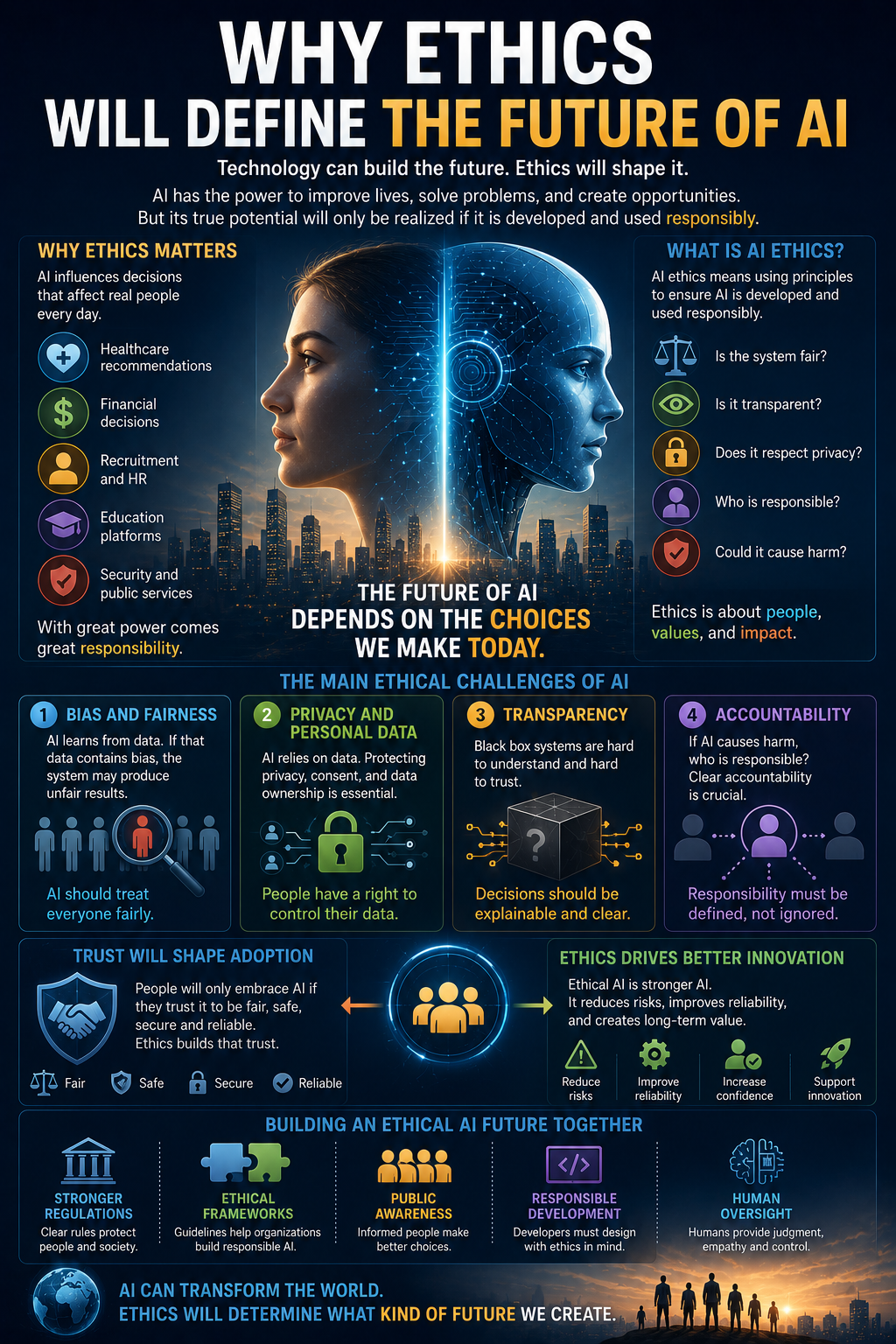
AI ethics refers to the principles used to ensure that Artificial Intelligence is developed and used responsibly.
It focuses on questions such as:
Is the system fair?
Is it transparent?
Does it respect privacy?
Who is responsible for its actions?
Could it cause harm?
Ethics is not simply about rules.
It is about making decisions that consider both technology and human impact.
Why Ethics Matters More Than Ever
AI is becoming part of decisions that affect real people.
Examples include:
Healthcare recommendations
Financial decisions
Recruitment systems
Education platforms
Security systems
Public services
When AI influences important aspects of life, mistakes can have significant consequences.
Without ethical principles, powerful technology can create problems instead of solving them.
The Main Ethical Challenges of AI
1. Bias and Fairness
AI learns from data.
If that data contains imbalance or bias, the system may produce unfair results.
Questions arise such as:
Are all groups treated fairly?
Are outcomes balanced?
Are hidden biases affecting decisions?
Fairness will remain a major challenge in future AI systems.
2. Privacy and Personal Data
AI often relies on large amounts of information.
This creates concerns about:
Data collection
User consent
Data ownership
Personal privacy
People increasingly want to know:
👉 Who has access to my information?
3. Transparency
Some AI systems operate as complex "black boxes."
This means:
Users may not understand how decisions are made
Explanations may be unclear
Trust becomes more difficult
People want AI systems that are understandable and explainable.
4. Accountability
If an AI system causes harm, who is responsible?
Questions may include:
The developer?
The company?
The user?
The organization deploying it?
As AI becomes more autonomous, accountability becomes increasingly important.
Trust Will Shape Adoption
Technology only succeeds when people trust it.
Even highly advanced AI systems may face resistance if users believe they are:
Unfair
Unsafe
Invasive
Unpredictable
Ethics helps build trust.
Without trust:
👉 adoption slows down.
Why Ethics Is Also Good for Innovation
Some people think ethics slows progress.
But responsible development often creates stronger systems.
Ethical design can:
✔ Reduce risks
✔ Improve reliability
✔ Increase user confidence
✔ Support long-term growth
In many cases, ethics does not limit innovation.
It improves it.
The Role of Businesses and Developers
Ethical AI is not only the responsibility of governments.
Companies and developers also play an important role.
They can:
Build transparent systems
Test for fairness
Protect user data
Monitor real-world impact
Maintain human oversight
Responsible development begins long before AI reaches users.
What the Future May Look Like
In the coming years, we will likely see:
Stronger AI regulations
Greater transparency requirements
More ethical frameworks
Increased public awareness
Better accountability systems
Future AI systems may not only be judged by performance.
They may also be judged by:
👉 how responsibly they operate
Conclusion
Artificial Intelligence has enormous potential to improve our lives.
But technology alone is not enough.
The future of AI will depend not only on what machines can do…
It will depend on:
✔ Fairness
✔ Transparency
✔ Responsibility
✔ Trust
✔ Human values
Because in the end, the most powerful AI may not be the fastest or the smartest.
👉 It may be the AI that people trust the most.
Synergy
Explore AI and creativity through engaging tutorials.
Innovate
Empower
contact@humanandai.net
© 2026. All rights reserved.