Who Controls AI in 2026?
Introduction Artificial Intelligence is now part of everyday life. It helps us search for information, recommend content, automate work, analyze data, and support decision-making in businesses, governments, and public services. As AI becomes more powerful and more present, one important question naturally follows: 👉 Who actually controls AI? Is it the companies that build it? Governments that regulate it? Or the people who use it every day? In 2026, the answer is more complex than it may first appear.
The Companies Building AI
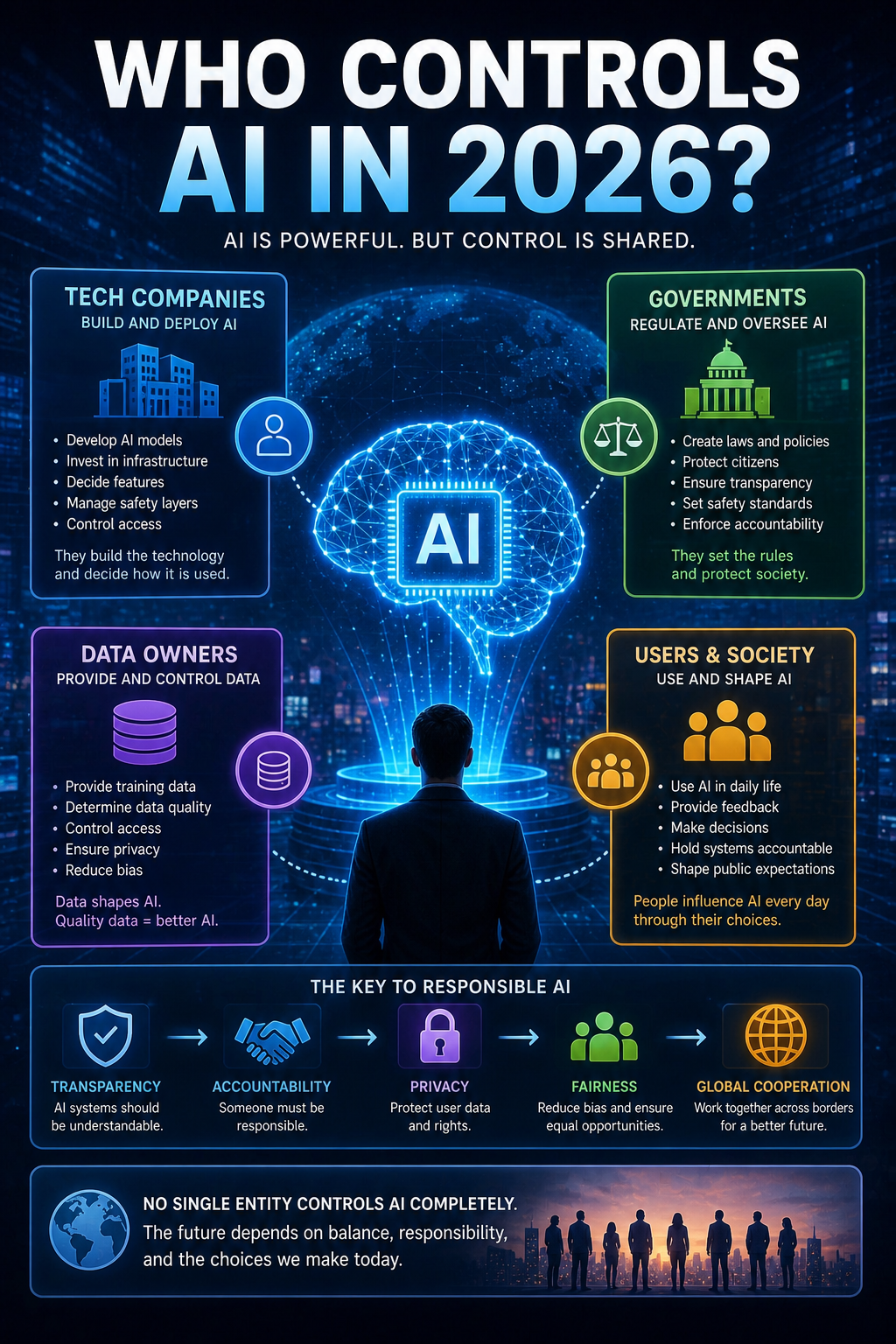
Today, many of the most advanced AI systems are developed by major technology companies.
These organizations invest enormous resources in:
Research and development
Computing infrastructure
Large-scale data processing
AI model training
Security and deployment
Because of this, private companies currently have a major influence over how advanced AI systems are created and released.
They often decide:
What the models can do
How they are deployed
What safety rules are included
Which users or industries can access them
In many ways, companies are currently the main builders of modern AI.
The Role of Governments and Regulation
As AI becomes more influential, governments are becoming more involved.
In 2026, many countries are working on regulations that address:
Privacy and data protection
Transparency
Safety standards
Responsible deployment
Accountability for harmful outcomes
The goal is not to stop innovation.
The goal is to ensure AI develops in ways that protect society.
Governments do not build most AI systems directly, but they increasingly define the rules under which AI operates.
The People Who Use AI
Control also exists at the user level.
Every day, millions of people influence AI through:
The way they use it
The feedback they provide
The tasks they automate
The decisions they accept or reject
AI does not operate in isolation.
Humans decide:
Whether to trust its output
When to verify results
How much responsibility to give automated systems
This means users also play an important role in shaping AI’s real-world impact.
Data: One of the Biggest Sources of Control
AI learns from data.
That means whoever controls data often has significant influence over AI.
Important questions include:
What data is used to train models?
Is the data accurate?
Is it balanced?
Who owns it?
Who is allowed to access it?
Data quality strongly affects AI behavior.
Poor or biased data can lead to poor or biased results.
In many ways, data governance is one of the most important forms of AI control.
Can AI Control Itself?
This is often misunderstood.
AI can:
Analyze patterns
Make predictions
generate responses
automate tasks
But AI does not independently define goals, values, or responsibility.
It does not decide what society should want.
Humans still define:
Objectives
Boundaries
Priorities
Risk tolerance
AI can operate with increasing autonomy in specific environments — but it does not govern itself in the human sense.
The Challenge of Global Control
One major difficulty is that AI is global.
Technology moves across:
Countries
Industries
Platforms
Legal systems
Different regions may have different rules, priorities, and standards.
This creates challenges:
How do we regulate globally used systems?
How do we balance innovation with safety?
Who sets international standards?
These questions are becoming increasingly important.
What Control Should Look Like
The most effective AI control is not about one single group having all power.
It requires balance.
Companies
build and improve the technology.
Governments
set rules, standards, and accountability.
Users
apply judgment and responsible use.
Experts and society
help define ethical boundaries.
Good control is not about stopping progress.
It is about guiding it responsibly.
What This Means for the Future
As AI becomes more capable, the question of control will become even more important.
In the coming years, we will likely see:
More regulation
Stronger governance frameworks
Better transparency requirements
More public discussion about responsibility and trust
The future of AI will depend not only on what machines can do…
👉 but on how humans choose to manage that power.
Conclusion
So, who controls AI in 2026?
The honest answer is:
👉 No single person or organization controls it completely.
Control is shared between:
The companies building AI
Governments creating rules
The data shaping systems
The people using the technology
Artificial Intelligence is powerful.
But the direction it takes will ultimately depend on human decisions.
And that may be the most important part of all.
Synergy
Explore AI and creativity through engaging tutorials.
Innovate
Empower
contact@humanandai.net
© 2026. All rights reserved.