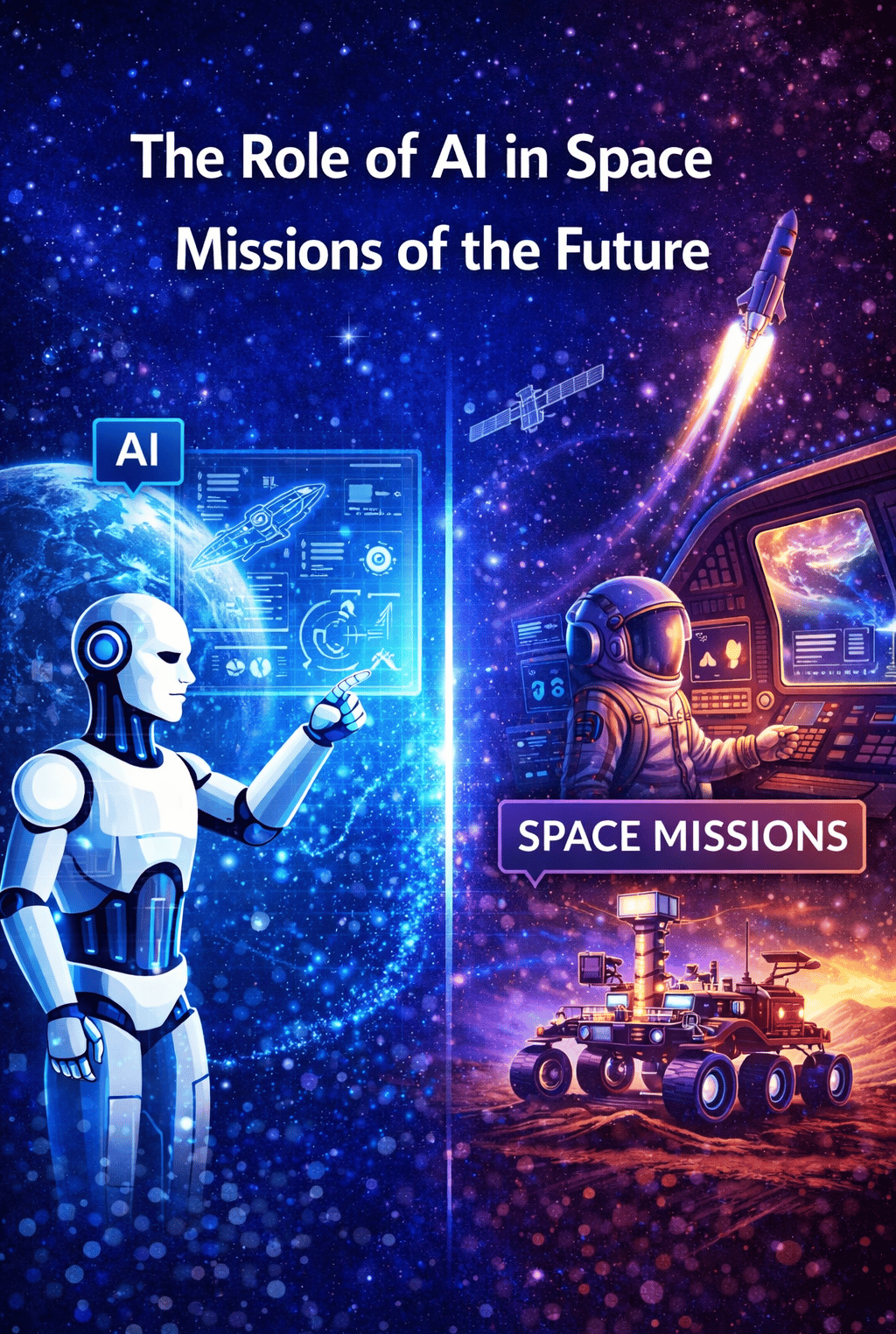
The Role of AI in Space Missions of the Future
Introduction Space exploration has always pushed the limits of human innovation. From landing on the Moon to exploring distant planets, every mission requires precision, intelligence, and advanced technology. Today, Artificial Intelligence is becoming a key part of this journey. As space missions grow more complex and ambitious, AI is helping scientists and engineers explore deeper into space, make faster decisions, and operate systems far beyond human reach. Let’s explore how AI will shape the future of space missions.
Why AI Is Essential for Space Exploration
Space is one of the most challenging environments imaginable.
Missions face:
Extreme distances
Communication delays
Harsh conditions
Limited human intervention
For example, communication between Earth and Mars can take up to 20 minutes one way.
👉 That means spacecraft must often operate independently.
This is where AI becomes critical.
Autonomous Spacecraft Operations
Future spacecraft will rely heavily on AI to function autonomously.
AI systems can:
Navigate through space
Adjust trajectories
Manage onboard systems
Detect and respond to issues
Instead of waiting for instructions from Earth, spacecraft can make decisions in real time.
This increases mission success and reduces risk.
AI in Navigation and Landing
Landing on another planet is one of the most complex parts of any mission.
AI helps by:
Analyzing terrain in real time
Avoiding obstacles
Selecting safe landing zones
Adjusting descent dynamically
This has already been demonstrated in missions to Mars, where AI-assisted systems helped guide landers safely to the surface.
Robotic Exploration Powered by AI
AI-driven robots and rovers are essential for exploring environments that are too dangerous for humans.
These systems can:
Analyze soil and rock samples
Capture and process images
Navigate unknown terrain
Conduct scientific experiments
Future AI-powered robots will be even more advanced, capable of learning and adapting during missions.
Data Analysis and Scientific Discovery
Space missions generate massive amounts of data.
AI helps scientists:
Process large datasets quickly
Identify patterns and anomalies
Discover new phenomena
Prioritize important findings
Without AI, analyzing this data would take years.
With AI, discoveries can happen much faster.
AI in Mission Planning
Planning a space mission involves thousands of variables.
AI can assist by:
Optimizing mission routes
Managing resources efficiently
Simulating different scenarios
Reducing risks
This helps mission planners make better decisions before the mission even begins.
Supporting Human Astronauts
In future missions, especially long-duration ones (like Mars missions), AI will support astronauts directly.
AI can:
Monitor health and vital signs
Assist with daily tasks
Provide decision support
Act as an onboard assistant
In deep space, astronauts may rely heavily on AI as a companion and support system.
Challenges and Risks
Despite its potential, using AI in space comes with challenges:
Systems must be extremely reliable
Errors can be critical
Limited ability to update systems remotely
Cybersecurity concerns
AI systems must be carefully designed and tested before being deployed in space missions.
The Future of AI in Space
Looking ahead, AI will enable:
Fully autonomous space probes
Smarter space stations
AI-driven planetary exploration
Advanced collaboration between humans and machines
We may even see AI systems helping design future missions or discover new planets.
Conclusion
Artificial Intelligence is becoming a vital part of modern space exploration.
By enabling autonomous operations, improving data analysis, and supporting astronauts, AI is helping humanity push further into the unknown.
The future of space missions will not be driven by humans alone.
👉 It will be powered by the collaboration between human intelligence and artificial intelligence.
And together, they will take us further than ever before.
Synergy
Explore AI and creativity through engaging tutorials.
Innovate
Empower
contact@humanandai.net
© 2026. All rights reserved.