How to Use AI Without Losing Your Skills
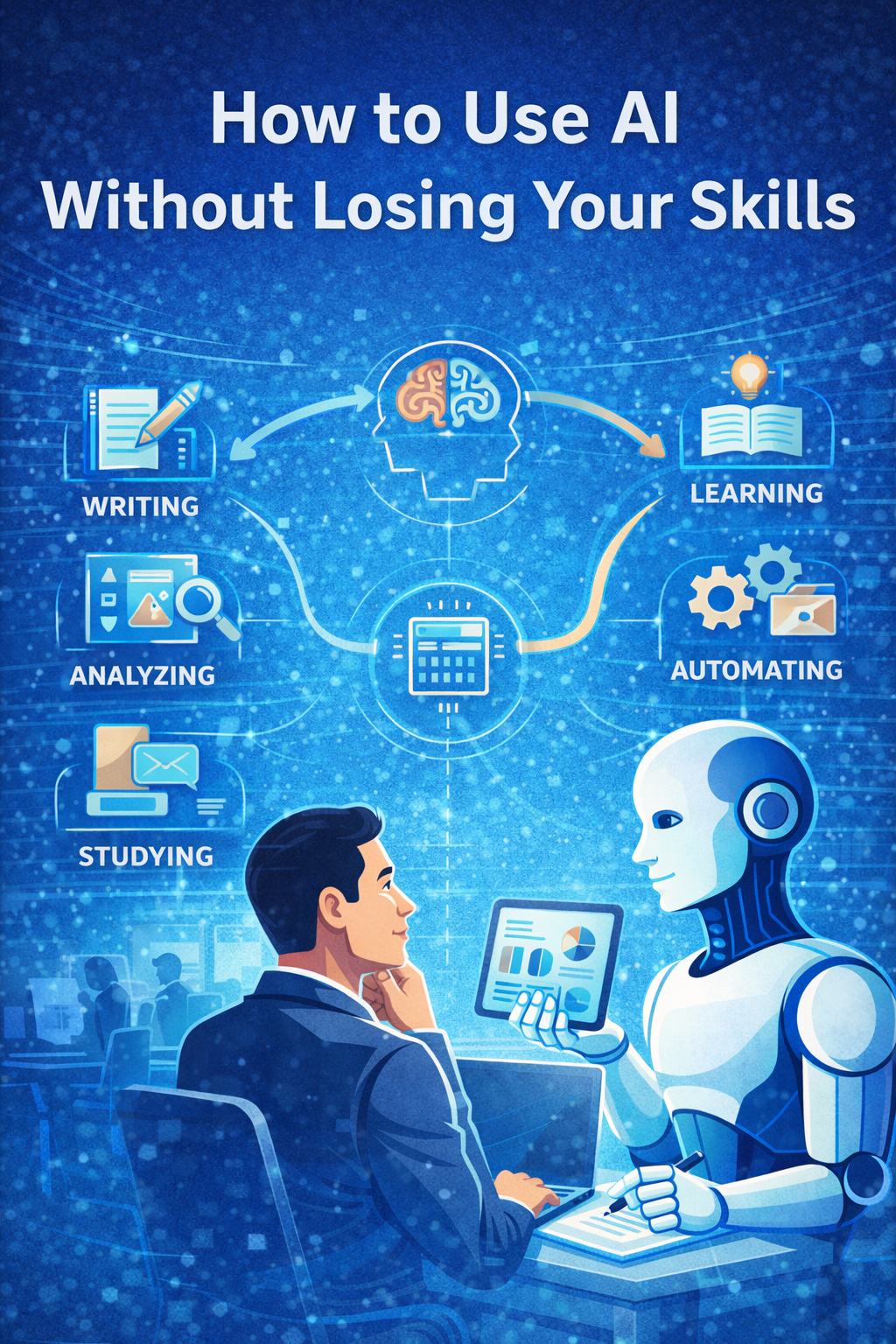
Artificial Intelligence is becoming part of our daily routines. We use AI to write emails, generate ideas, summarize documents, solve problems, and even make decisions. But this raises an important concern: If AI does more and more for us… what happens to our own skills? Will we become smarter by using AI — or more dependent? The good news is that AI does not have to replace your abilities. In fact, when used correctly, AI can strengthen your thinking, creativity, and expertise rather than weaken them. Let’s explore how.
The Real Risk Isn’t AI – It’s Passive Use
AI itself is not the danger.
The real risk is how we use it.
There are two very different approaches:
Passive Use
→ “AI, do this for me.”
→ Copy → Paste → Done.
Active Use
→ “AI, help me think.”
→ Review → Adjust → Improve.
When AI becomes a shortcut for thinking, learning, or creating, your brain slowly disengages. Like a muscle that is never exercised, skills begin to weaken.
But when AI becomes a collaborator, your abilities actually grow.
Use AI as a Partner, Not a Replacement
Instead of asking AI to replace your work, ask it to support your thinking.
Examples:
❌ Weakening Approach
“Write this entire report for me.”
✅ Skill-Preserving Approach
“Help me structure this report.”
“Suggest improvements for this paragraph.”
“Challenge my idea.”
This keeps your brain in control.
You remain the creator. AI becomes the assistant.
Always Think Before You Ask
A powerful habit:
👉 Try first. Ask second.
Before using AI:
• Attempt the problem
• Form your own opinion
• Write your own draft
• Think through the solution
Then use AI to:
• Refine
• Validate
• Expand
• Improve
This transforms AI into a learning accelerator rather than a thinking substitute.
Interrogate AI’s Answers
Never treat AI responses as final truth.
Instead, ask:
• Does this make sense?
• Is something missing?
• Would I say it this way?
• Is this accurate?
Better yet:
👉 Ask AI to debate you.
Example:
“Here is my idea. What are the weaknesses?”
“Give me counterarguments.”
“Challenge my assumptions.”
This actively sharpens critical thinking.
Protect Your Core Skills
Some abilities should always stay “human-driven”:
✅ Critical thinking
✅ Decision-making
✅ Creativity
✅ Problem-solving
✅ Communication
✅ Learning
AI can assist these skills — but should not replace them.
For example:
AI can help brainstorm ideas.
But you decide which idea matters.
AI can suggest solutions.
But you judge what is realistic.
AI can write drafts.
But you shape the final voice.
Use AI to Learn, Not Just Produce
One of the best uses of AI:
👉 Learning companion
Instead of:
“Give me the answer.”
Try:
“Explain this like I’m a beginner.”
“Teach me step by step.”
“Test my understanding.”
“Ask me questions.”
Now AI becomes a teacher, not a crutch.
The Brain Muscle Principle
Your brain works like a muscle:
Use it → It grows
Ignore it → It weakens
AI should increase mental activity, not reduce it.
Good AI use feels like:
✔ Thinking more
✔ Questioning more
✔ Exploring more
✔ Understanding deeper
Bad AI use feels like:
✔ Clicking faster
✔ Thinking less
✔ Copying blindly
✔ Learning nothing
The Ideal Relationship with AI
The healthiest mindset:
👉 AI is an amplifier of human intelligence.
Not a replacement.
Not an authority.
Not a substitute for thinking.
You remain:
• The decision-maker
• The thinker
• The creative force
• The responsible agent
AI becomes:
• The accelerator
• The assistant
• The idea generator
• The analytical helper
Final Thoughts
AI is one of the most powerful tools humans have ever created.
Like any powerful tool, its impact depends entirely on how we choose to use it.
Used passively → Skills decline
Used actively → Skills expand
The goal is not to compete with AI.
The goal is to grow alongside it.
Because the future does not belong to humans or AI.
It belongs to humans who know how to work with AI.
Synergy
Explore AI and creativity through engaging tutorials.
Innovate
Empower
contact@humanandai.net
© 2026. All rights reserved.