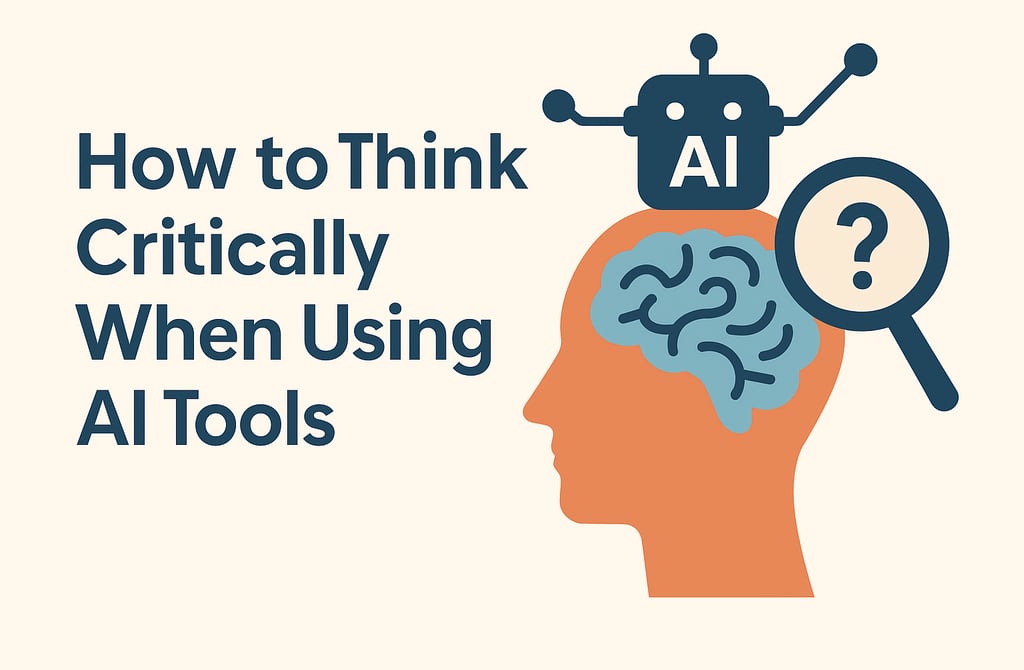
How to Think Critically When Using AI Tools
Artificial Intelligence has become part of our daily lives. We use it to write emails, generate ideas, solve problems, and even make decisions. While AI is incredibly powerful, it is not perfect. That’s why learning how to think critically when using AI tools is more important than ever. In this article, we’ll explore why critical thinking matters and how you can use AI wisely without losing your own judgment.
What Does “Thinking Critically” Mean in the AI Age?
Critical thinking means:
Questioning information
Checking facts
Understanding context
Making your own decisions
When using AI, it means you don’t accept everything it gives you as 100% correct. Instead, you analyze, evaluate, and improve the output.
AI should support your thinking — not replace it.
Why You Shouldn’t Trust AI Blindly
Even advanced AI systems can:
Make factual mistakes
Misinterpret questions
Show bias
Provide outdated information
Give oversimplified answers
AI learns from data created by humans. That means it can inherit human errors and limitations.
Trusting AI without verification can lead to bad decisions, misunderstandings, or even serious problems.
1. Always Ask: “Is This Accurate?”
Whenever AI gives you an answer, ask yourself:
Does this make sense?
Can I verify it elsewhere?
Does it match what I already know?
For important topics like health, finance, or legal matters, always double-check with reliable sources.
AI is a starting point — not the final authority.
2. Understand the Context
AI does not truly “understand” situations like humans do. It works based on patterns and probabilities.
Sometimes, it may give:
Generic advice
Answers that don’t fit your situation
Information without real-life context
Before using AI’s suggestions, think about your personal circumstances and environment.
What works for one person may not work for you.
3. Use AI as a Partner, Not a Boss
The best way to use AI is as a collaborator.
Let AI help you:
Generate ideas
Organize thoughts
Speed up research
Improve drafts
But you should:
Make the final decisions
Add your personal experience
Adjust the results
Take responsibility
You are in control — AI is your assistant.
4. Be Aware of Bias and Limitations
AI systems are trained on large datasets that may include:
Cultural bias
Political opinions
Stereotypes
Incomplete perspectives
This means some answers may favor certain viewpoints.
Critical thinkers always look at multiple perspectives and avoid relying on a single source — even if that source is AI.
5. Ask Better Questions for Better Results
The quality of AI’s answers depends on the quality of your questions.
Instead of:
❌ “Explain AI.”
Try:
✅ “Explain AI in simple terms for beginners with examples.”
Clear, detailed questions lead to better and more useful answers.
This is called prompting, and it’s becoming a key digital skill.
6. Don’t Stop Learning on Your Own
If you rely too much on AI, you may stop practicing important skills like:
Research
Writing
Problem-solving
Decision-making
Use AI to support your learning, not replace it.
Read books, follow experts, take courses, and experiment yourself. AI should help you grow — not make you passive.
7. Protect Your Privacy and Data
When using AI tools, think carefully about what you share.
Avoid entering:
Personal documents
Passwords
Sensitive company data
Private conversations
Critical thinking also means being responsible with your digital footprint.
The Balance Between Intelligence and Artificial Intelligence
AI is one of the most powerful tools humans have ever created. But power without wisdom can be dangerous.
The future belongs to people who can combine:
🧠 Human judgment
🤖 Artificial intelligence
❤️ Ethical responsibility
When you think critically, you don’t just use AI — you master it.
Conclusion
Thinking critically when using AI tools is not optional anymore — it’s essential.
Remember:
Question the output
Verify important information
Stay curious
Keep learning
Stay in control
AI is here to stay. The key is learning how to work with it intelligently.
Together, humans and AI can achieve amazing things — when guided by thoughtful minds.
Synergy
Explore AI and creativity through engaging tutorials.
Innovate
Empower
contact@humanandai.net
© 2026. All rights reserved.