How AI Is Reshaping Office Jobs in 2026
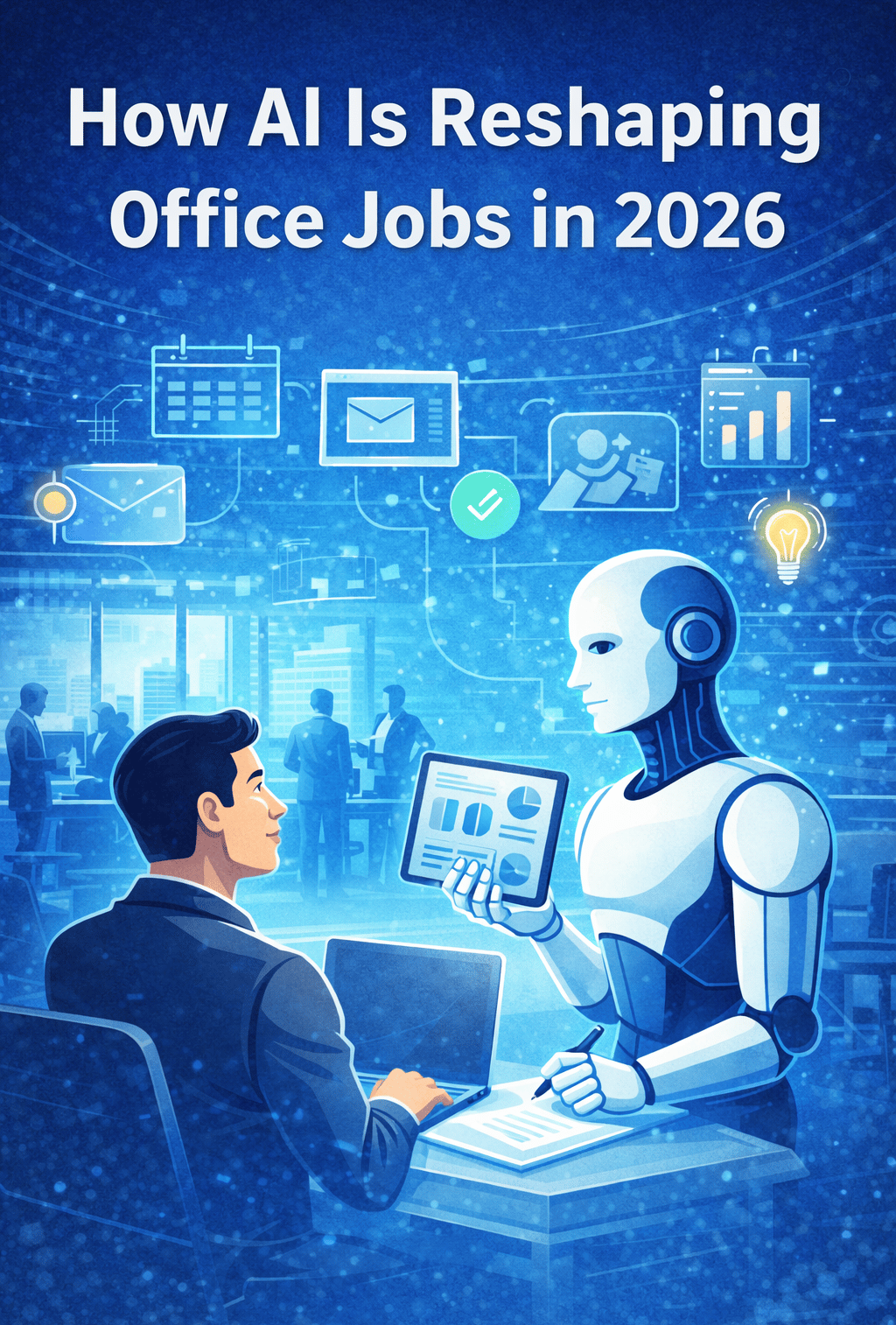
Artificial Intelligence is no longer a futuristic concept — it has become a daily workplace companion. From emails and scheduling to data analysis and decision support, AI tools are quietly transforming how office work gets done. But what does this shift actually mean for employees? Are jobs disappearing, or are they simply evolving? Let’s explore how AI is reshaping office jobs in 2026.
The Office Has Changed — Even If It Looks the Same
At first glance, modern offices may not seem dramatically different. People still attend meetings, write reports, manage projects, and communicate with colleagues.
The real transformation is happening behind the scenes.
AI now assists with:
Drafting emails and documents
Organizing schedules and meetings
Analyzing data and generating reports
Automating repetitive administrative tasks
Providing insights for decision-making
The tools are new, but the workspace often looks familiar.
Automation of Repetitive Tasks
One of AI’s biggest impacts is the automation of routine work.
Tasks that once consumed hours can now be completed in minutes:
Formatting documents
Creating summaries
Data entry
Basic customer responses
Generating templates
This doesn’t necessarily eliminate jobs — but it changes how time is spent.
Employees can focus more on:
Strategy
Creativity
Problem-solving
Human interaction
AI as a Productivity Multiplier
In 2026, AI is best understood as a productivity amplifier.
Instead of replacing workers, AI often acts as a digital assistant:
Helping write faster
Finding information instantly
Generating ideas
Reducing manual workload
A single employee can now handle tasks that previously required multiple people.
This shift rewards those who know how to collaborate effectively with AI.
New Skills Are Becoming Essential
Traditional office skills are no longer enough on their own.
Employees increasingly benefit from:
AI literacy – understanding what AI can and cannot do
Prompting skills – asking AI better questions
Critical thinking – evaluating AI outputs
Adaptability – learning new tools quickly
The most valuable workers are not those who compete with AI, but those who leverage it.
The Rise of “Human-Centered” Work
As AI handles more technical and repetitive tasks, human strengths become more important.
Skills that gain value include:
Communication
Emotional intelligence
Leadership
Negotiation
Creativity
Ethical judgment
Ironically, the more advanced AI becomes, the more human qualities matter.
Changing Job Roles, Not Just Job Numbers
Many office jobs are not disappearing — they are evolving.
Examples:
Administrative Roles → Digital Workflow Coordinators
Managing AI tools, automations, and processes.
Data Analysts → Insight Interpreters
Translating AI-generated analysis into business decisions.
Content Creators → AI-Enhanced Creators
Using AI to accelerate production while adding originality.
Job titles may remain similar, but responsibilities shift.
Potential Challenges in the AI-Driven Office
The transition is not without difficulties.
Common concerns include:
Fear of job displacement
Over-reliance on AI
Loss of certain manual skills
Ethical dilemmas
Data privacy risks
Organizations and employees must learn to balance efficiency with responsibility.
The Psychological Shift: Working With Machines
Perhaps the biggest change is mental rather than technical.
Employees are adjusting to:
Collaborating with AI systems
Delegating tasks to algorithms
Trusting (but verifying) machine outputs
Redefining their professional value
Success increasingly depends on mindset, not just skillset.
Opportunities Created by AI
While AI disrupts some workflows, it also creates new opportunities:
New job categories
Faster career growth for adaptable workers
Reduced burnout from repetitive work
More focus on meaningful tasks
Greater accessibility for smaller businesses
AI is both a challenge and an enabler.
The Future Office Worker
The successful office worker in 2026 is:
Technologically comfortable
Curious and adaptable
Skilled in critical thinking
Focused on uniquely human abilities
Able to treat AI as a collaborator
The question is no longer:
❌ “Will AI take my job?”
But rather:
✅ “How can AI help me do my job better?”
Conclusion
AI is reshaping office jobs not by replacing humans, but by redefining how work is performed.
Routine tasks shrink. Strategic and human-centered tasks grow.
Those who embrace AI as a tool will thrive. Those who resist may struggle.
In the end, AI is not eliminating the office — it is reinventing it.
And as always, the future belongs to those willing to evolve.
Synergy
Explore AI and creativity through engaging tutorials.
Innovate
Empower
contact@humanandai.net
© 2026. All rights reserved.