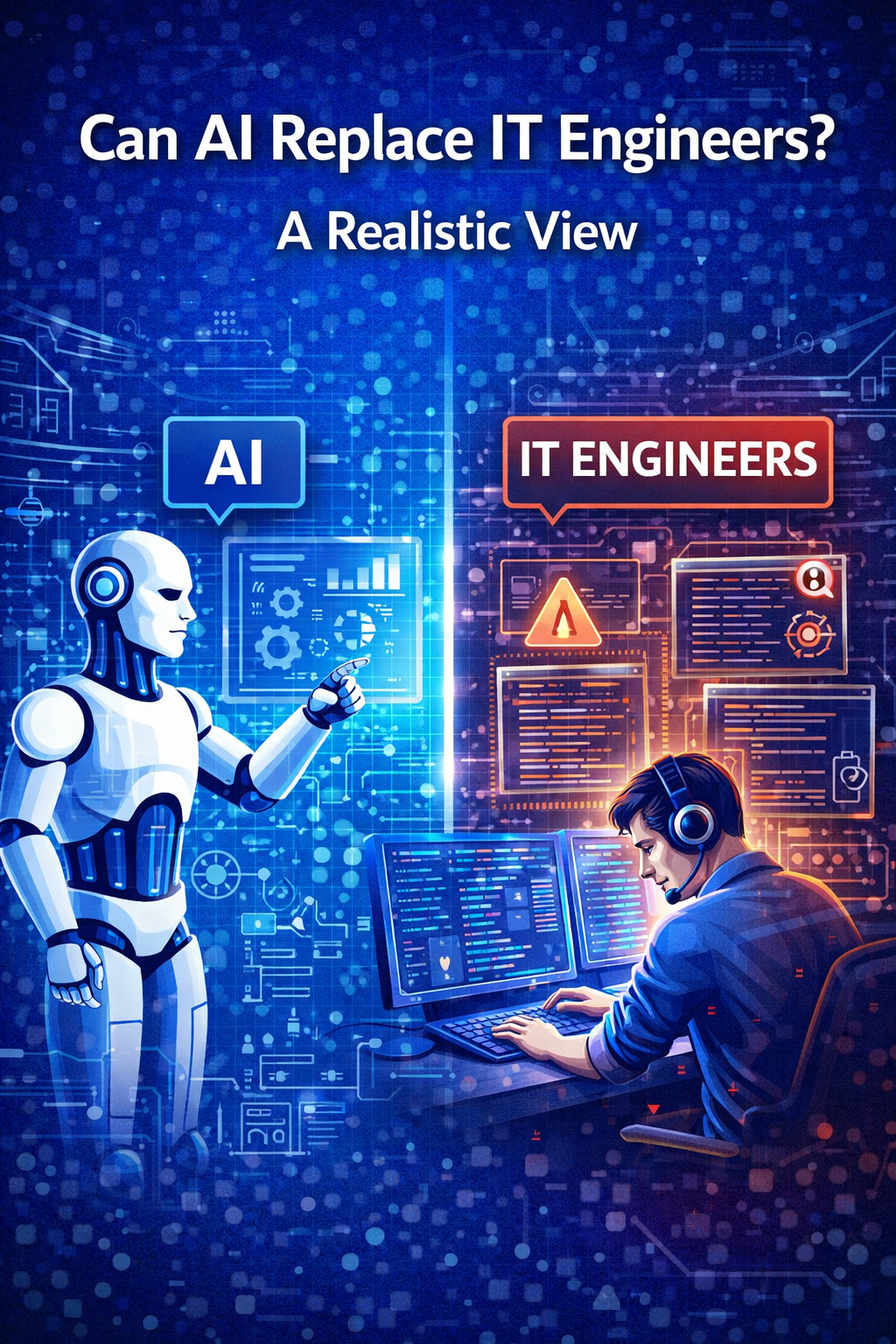
Can AI Replace IT Engineers? A Realistic View
With the rapid rise of Artificial Intelligence, a common question keeps coming up: 👉 Will AI replace IT engineers? From automated systems to self-healing infrastructure and intelligent troubleshooting tools, it may seem like machines are taking over more and more responsibilities. But how realistic is this idea? In this article, we’ll take a clear and honest look at what AI can do today — and whether it can truly replace IT engineers.
Why People Think AI Will Replace IT Engineers
There are several reasons why this fear exists.
AI is already capable of:
Automating repetitive tasks
Analyzing large volumes of data
Detecting system anomalies
Assisting with troubleshooting
Generating scripts and configurations
When you look at these capabilities, it’s easy to think:
👉 “If AI can do all this… what’s left for humans?”
What AI Can Actually Do Today
Let’s be realistic — AI is already helping IT engineers significantly.
✅ 1. Automation of Routine Tasks
AI can handle:
Log analysis
System monitoring
Basic troubleshooting
Deployment scripts
Routine maintenance
This reduces manual workload and improves efficiency.
✅ 2. Faster Problem Detection
AI can detect issues faster than humans by:
Monitoring systems in real time
Identifying unusual behavior
Predicting potential failures
This helps prevent downtime and improves system reliability.
✅ 3. Assistance in Troubleshooting
AI can:
Suggest possible causes of issues
Correlate logs and events
Provide recommendations
But it doesn’t fully solve complex problems on its own.
What AI Cannot Replace
Despite its capabilities, AI still has major limitations.
❌ 1. System Design and Architecture
IT engineers are responsible for:
Designing infrastructure
Choosing technologies
Planning scalability
Ensuring reliability
AI does not understand business needs or long-term strategy the way humans do.
❌ 2. Critical Decision-Making
In complex situations, decisions require:
Context
Experience
Risk evaluation
Understanding of business impact
AI can provide suggestions — but humans make the final call.
❌ 3. Handling Unexpected Situations
Real-world IT environments are unpredictable.
When something unusual happens:
AI may not recognize the scenario
Automation may fail
Human creativity is required
This is where experienced engineers are essential.
❌ 4. Responsibility and Accountability
When systems fail, someone must take responsibility.
AI cannot:
Be accountable
Understand consequences
Take ownership of decisions
This responsibility always belongs to humans.
How AI Is Changing the Role of IT Engineers
AI is not replacing IT engineers — it is transforming their role.
Instead of focusing on repetitive tasks, engineers now focus more on:
System design
Strategy
Optimization
Security
Innovation
The role becomes more advanced, not obsolete.
The Rise of the AI-Augmented Engineer
The future is not about AI vs humans.
It’s about:
👉 AI + IT Engineers
Engineers who use AI effectively can:
Work faster
Solve problems more efficiently
Manage larger infrastructures
Deliver better results
This creates a new type of professional:
👉 The AI-augmented engineer
Who Is at Risk?
Let’s be honest — not everyone is equally safe.
The most at risk are:
❌ People who only perform repetitive tasks
❌ Those who refuse to learn new tools
❌ Those who rely on outdated skills
The safest professionals are:
✅ Adaptable
✅ Curious
✅ Continuously learning
✅ Comfortable working with AI
The Future of IT Engineering
In the coming years, we will likely see:
More automation
Smarter monitoring systems
AI-assisted troubleshooting
Increased reliance on intelligent tools
But IT engineers will still be essential.
In fact, they may become even more valuable.
Conclusion
AI is a powerful tool that is transforming IT operations — but it is not replacing IT engineers.
What AI does:
✔ Automates repetitive tasks
✔ Improves efficiency
✔ Provides insights
✔ Supports decision-making
What AI does NOT do:
❌ Replace human expertise
❌ Understand complex systems fully
❌ Take responsibility
❌ Make strategic decisions
The future is not about choosing between AI and humans.
It’s about learning how to combine both.
Because in the end, the most successful IT professionals will not be those replaced by AI…
👉 but those who know how to work with it.
Synergy
Explore AI and creativity through engaging tutorials.
Innovate
Empower
contact@humanandai.net
© 2026. All rights reserved.