Can AI Be Truly Neutral?
Introduction Artificial Intelligence is often seen as objective and impartial. Because AI uses algorithms, data, and mathematical models, many people assume it makes neutral decisions — free from emotions, opinions, or personal preferences. At first glance, that sounds logical. But the reality is more complex. Can AI truly be neutral, or does it always reflect human choices, data limitations, and the environment in which it is built? Let’s explore this important question.
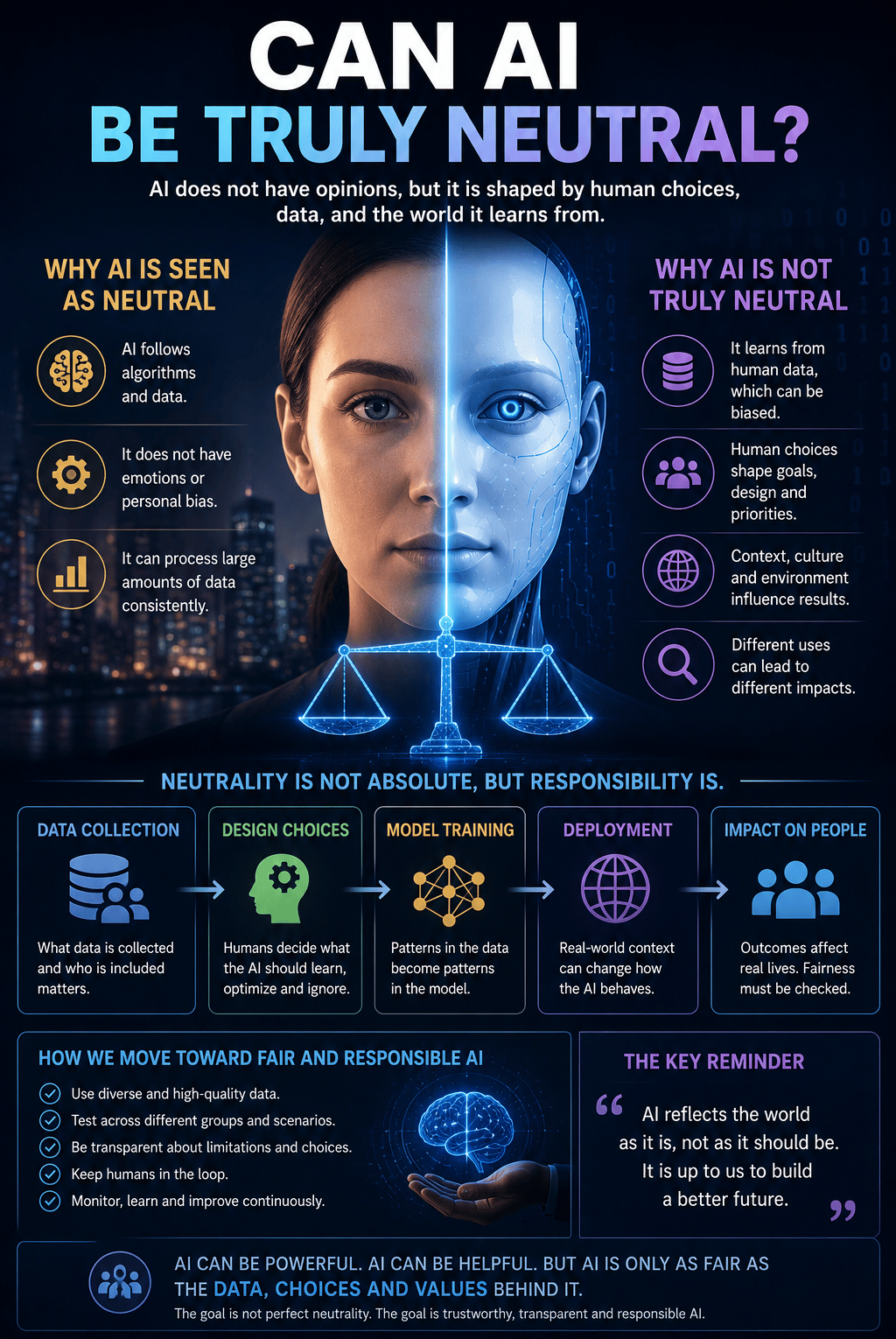
Why AI Appears Neutral
One reason people believe AI is neutral is because machines do not have human emotions.
AI does not feel:
anger
fear
personal ambition
favoritism
It processes inputs, identifies patterns, and generates outputs based on rules and training data.
From the outside, this can make AI seem objective.
But neutrality is not only about emotion.
It is also about how systems are designed, trained, and used.
AI Learns from Human Data
AI does not create knowledge on its own.
It learns from data created by humans and from patterns found in the real world.
That means AI can inherit:
historical imbalance
incomplete information
social patterns
existing assumptions
If the world reflected in the data is imperfect, the AI model may also reflect those imperfections.
In simple terms:
👉 AI learns from human reality — not from ideal neutrality.
Design Choices Also Matter
Neutrality is influenced long before the model is used.
Humans decide:
what data is collected
what goals the system should optimize
what success looks like
which risks are acceptable
which outcomes matter most
These are not purely technical decisions.
They involve priorities, judgment, and context.
Even well-designed systems reflect human choices.
Context Changes Everything
A system that appears neutral in one environment may not be neutral in another.
For example:
language differences
cultural expectations
local regulations
different user behavior
A model can perform very differently depending on where and how it is deployed.
This means neutrality is not universal.
It is often context-dependent.
Can Pure Neutrality Exist?
Realistically, complete neutrality is very difficult.
Why?
Because every AI system is shaped by:
data selection
model design
training objectives
human oversight
deployment context
At every stage, choices are made.
And every choice influences outcomes.
That does not mean AI is unfair by default.
It means absolute neutrality is probably not realistic.
What Matters More Than Perfect Neutrality
Instead of asking whether AI can be perfectly neutral, a better question may be:
👉 Can AI be responsible, transparent, and fair enough for the task it performs?
That is often more useful in practice.
The goal should be:
reducing harmful bias
improving transparency
testing across different scenarios
maintaining human oversight
continuously improving systems over time
Human Responsibility Remains Central
A common misunderstanding is that AI decisions belong only to the machine.
But humans still remain responsible for:
designing the system
selecting the data
defining acceptable behavior
monitoring results
correcting problems
AI may automate decisions.
It does not automate responsibility.
What This Means for the Future
As AI becomes more present in daily life, the question of neutrality will become even more important.
In the coming years, trust in AI will depend on:
better governance
stronger evaluation methods
transparency standards
public accountability
thoughtful human leadership
People will not only ask:
“Can it work?”
They will increasingly ask:
“Can it be trusted?”
Conclusion
Can AI be truly neutral?
The honest answer is:
👉 Probably not completely.
AI does not operate outside human reality.
It learns from human data, human choices, and human systems.
But that does not mean AI cannot be useful, responsible, or fair.
The goal should not be perfect neutrality.
It should be building AI that is transparent, trustworthy, and carefully guided by human judgment.
Because in the end, the future of AI will not depend only on machines…
👉 but on the values humans choose to build into them.
Synergy
Explore AI and creativity through engaging tutorials.
Innovate
Empower
contact@humanandai.net
© 2026. All rights reserved.