Bias in AI: Why It Still Matters
Introduction Artificial Intelligence is often seen as objective, logical, and data-driven. Because AI relies on algorithms and large datasets, many people assume it makes neutral decisions without human influence. But that is not always true. AI systems can reflect the biases present in the data they learn from, the assumptions built into their design, and the way they are deployed in the real world. That is why bias in AI still matters — and why it remains one of the most important discussions in the future of technology.
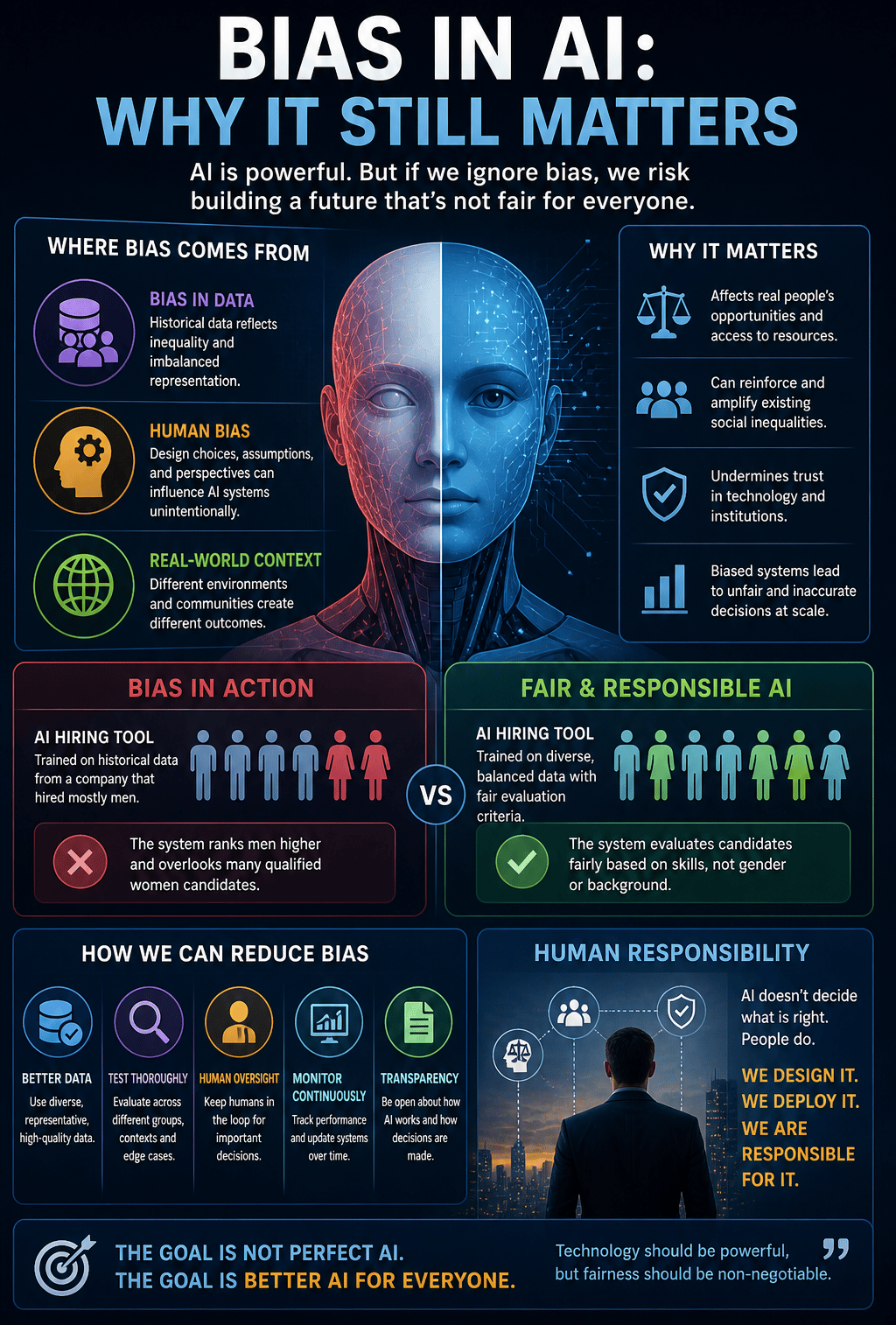
Where Bias Can Come From
There are several common sources of AI bias.
1. Training Data
AI depends heavily on data.
If training data is incomplete or unbalanced, the model may learn distorted patterns.
For example:
Some groups may be underrepresented
Historical decisions may already contain bias
Certain situations may not appear enough in the data
2. Human Design Choices
People decide:
What data to use
Which goals to optimize
How the system should behave
Which metrics matter most
Even with good intentions, design decisions can unintentionally introduce bias.
3. Real-World Deployment
A model may perform well in testing but behave differently in real-world environments.
Different populations, cultures, languages, and contexts can affect outcomes.
Why It Matters
Bias in AI matters because AI increasingly influences important areas of life.
Examples include:
Hiring and recruitment
Banking and lending
Healthcare
Education
Security systems
Public services
If biased systems are used at scale, they can affect thousands or even millions of people.
The impact becomes larger than a single human decision.
Bias Does Not Always Look Obvious
One important point is that bias is not always easy to notice.
Sometimes AI can appear accurate overall while still performing poorly for specific groups or situations.
For example:
High average accuracy can hide uneven results
Rare cases may be ignored
Certain users may experience worse outcomes without realizing why
This makes careful evaluation essential.
Can Bias Be Eliminated Completely?
Realistically, probably not.
Why?
Because:
Data reflects imperfect human societies
Context changes over time
New environments create new challenges
The goal is not perfection.
The goal is continuous improvement, transparency, and responsible oversight.
How Bias Can Be Reduced
There are practical ways to reduce bias.
Use better and more representative data
Diverse and high-quality data helps improve fairness.
Test systems in different scenarios
AI should be evaluated across multiple groups, environments, and edge cases.
Keep humans involved
Human review remains essential for important decisions.
Monitor systems after deployment
Bias can appear over time, so AI needs ongoing monitoring and adjustment.
Build transparent processes
People should understand how important AI decisions are made.
Why Human Responsibility Still Matters
A common misunderstanding is that once an AI system is deployed, responsibility shifts to the machine.
That is not true.
Humans still remain responsible for:
The design
The training data
The deployment choices
The monitoring process
The impact on users
AI does not create ethical responsibility.
People do.
What This Means for the Future
As AI becomes more integrated into society, bias will remain an important issue.
The future will require:
Better governance
Stronger testing standards
More transparency
More public discussion
More responsible development practices
Trust in AI will depend not only on what systems can do…
👉 but also on whether people believe they are fair.
Conclusion
Bias in AI still matters because AI increasingly shapes real decisions in the real world.
Even advanced systems can inherit imperfect data, human assumptions, and hidden imbalances.
The solution is not to reject AI.
It is to build it more carefully.
Because the future of Artificial Intelligence should not only be about speed, power, and automation…
👉 It should also be about fairness, responsibility, and trust.
Synergy
Explore AI and creativity through engaging tutorials.
Innovate
Empower
contact@humanandai.net
© 2026. All rights reserved.