AI Tools Every Professional Should Know
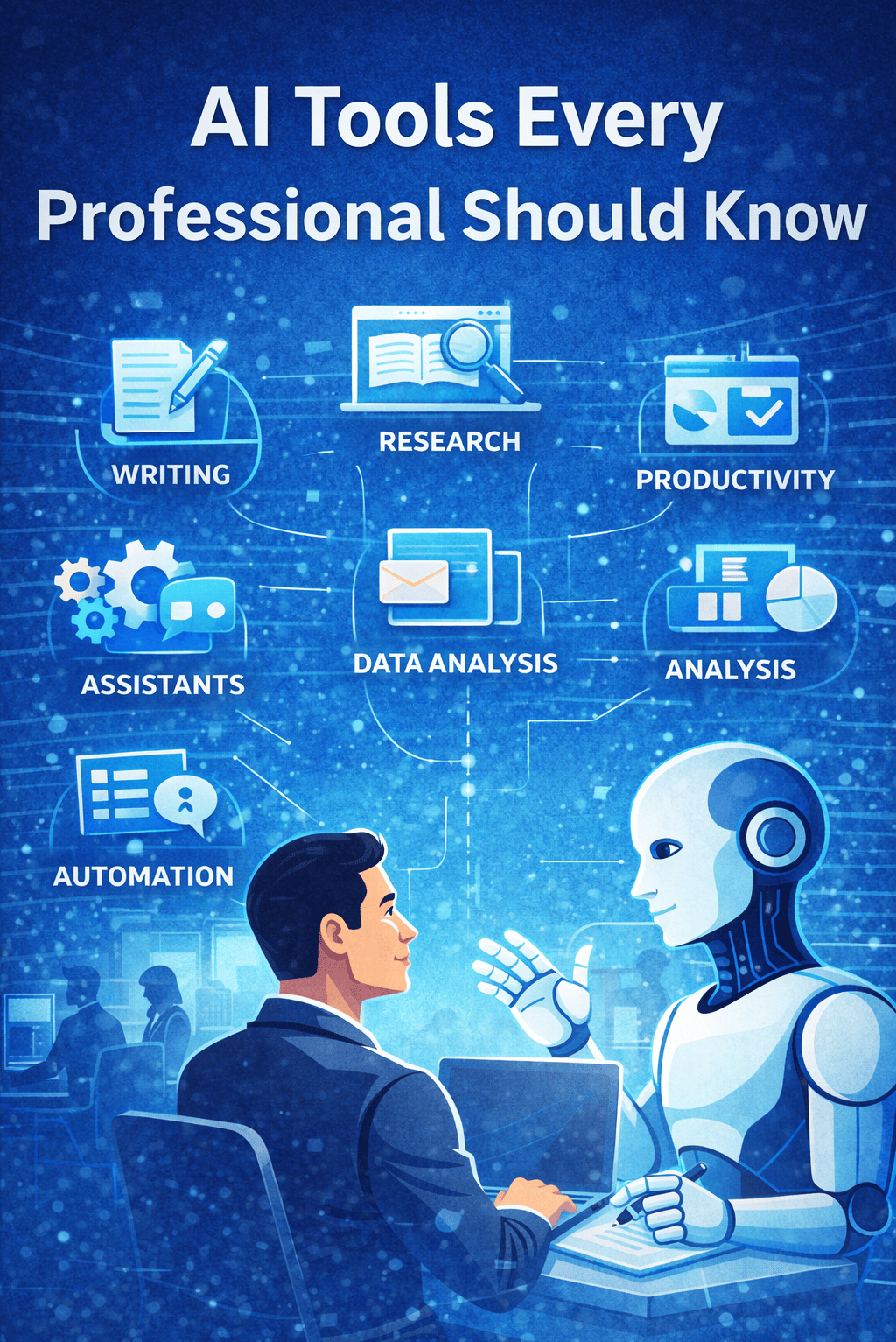
Artificial Intelligence is no longer reserved for researchers or tech experts. In 2026, AI tools have become essential companions for professionals across nearly every industry. Whether you work in IT, business, marketing, education, finance, or administration, knowing how to use AI can significantly boost your efficiency and performance. Let’s explore the types of AI tools every modern professional should be familiar with.
Why AI Tools Matter in Today’s Workplace
The modern workplace is faster, more competitive, and increasingly digital.
AI tools help professionals:
Save time
Reduce repetitive work
Improve accuracy
Generate ideas
Make better decisions
Instead of replacing human skills, AI amplifies them.
Those who adopt AI gain a major advantage.
1. AI Writing & Communication Tools
Clear communication is critical in every profession.
AI writing assistants can help with:
Emails
Reports
Presentations
Proposals
Documentation
They can:
Improve grammar and clarity
Adjust tone (formal, friendly, persuasive)
Generate drafts quickly
Summarize long texts
These tools are especially valuable when time is limited.
2. AI Research & Knowledge Tools
Professionals constantly search for information.
AI research tools can:
Explain complex topics
Summarize articles
Compare concepts
Generate ideas
Provide structured answers
Instead of spending hours browsing, you can get instant insights.
But remember: always verify critical information.
3. AI Productivity & Organization Tools
Managing tasks, meetings, and priorities can be overwhelming.
AI productivity tools assist with:
Scheduling
Task management
Workflow optimization
Smart reminders
Time analysis
They help reduce mental clutter and improve focus.
Think of them as digital organizers.
4. AI Data & Analysis Tools
Data is everywhere — but understanding it is the real challenge.
AI analysis tools can:
Interpret spreadsheets
Detect patterns
Generate reports
Create forecasts
Visualize information
Even non-technical professionals can benefit from AI-driven insights.
5. AI Design & Content Creation Tools
Visual communication is becoming increasingly important.
AI design tools help create:
Graphics
Presentations
Marketing visuals
Social media content
Concepts & mockups
They allow professionals to produce high-quality visuals without advanced design skills.
6. AI Automation Tools
Repetitive tasks drain productivity.
AI automation tools can handle:
Email sorting
Data processing
Workflow triggers
Document handling
Routine responses
Automation frees professionals to focus on higher-value work.
7. AI Assistants & Conversational Tools
AI assistants (like your favorite AB 😄) can act as:
Idea generators
Problem solvers
Learning companions
Brainstorming partners
Writing collaborators
They’re becoming everyday workplace companions.
The Key Skill: Knowing How to Work With AI
Simply having access to AI tools is not enough.
Professionals must learn:
How to ask better questions
How to evaluate AI outputs
When to rely on AI
When to use human judgment
How to combine both effectively
AI literacy is becoming a core professional skill.
Common Mistakes Professionals Should Avoid
Even experienced users can fall into traps:
❌ Blindly trusting AI
❌ Over-relying on automation
❌ Ignoring privacy risks
❌ Using AI without critical thinking
❌ Forgetting human creativity
AI should enhance your work — not control it.
The Competitive Advantage of AI-Savvy Professionals
Professionals who embrace AI often experience:
✅ Increased productivity
✅ Faster workflows
✅ Better decision-making
✅ Reduced stress
✅ More creative freedom
In many industries, AI skills are becoming as important as computer skills once were.
Conclusion
AI tools are no longer optional — they are becoming fundamental components of modern professional life.
The goal is not to replace human expertise, but to expand what professionals can achieve.
In 2026, success belongs to those who combine:
🧠 Human intelligence
🤖 Artificial intelligence
⚖️ Critical thinking
Learn the tools. Stay curious. Keep evolving.
Synergy
Explore AI and creativity through engaging tutorials.
Innovate
Empower
contact@humanandai.net
© 2026. All rights reserved.