AI Laws and Regulations Around the World
Introduction Artificial Intelligence is advancing rapidly and becoming part of many areas of modern life. From healthcare and finance to education and cybersecurity, AI systems are influencing how decisions are made and how services are delivered. But as AI grows more powerful, an important question arises: 👉 Who makes the rules? Governments and organizations around the world are increasingly working on laws and regulations to ensure that AI is used safely, responsibly, and fairly. In this article, we’ll explore how different regions are approaching AI regulation and why these rules matter.
Why AI Needs Regulation
Like any powerful technology, AI offers both opportunities and risks.
Benefits include:
Increased productivity
Better decision-making
Faster innovation
Improved services
However, concerns also exist:
Privacy issues
Biased outcomes
Security risks
Misinformation
Lack of transparency
Without clear rules, AI systems could create unintended consequences.
The purpose of regulation is not to stop progress.
The goal is:
👉 to guide innovation responsibly.
Different Countries, Different Approaches
One of the biggest challenges is that AI is global, while laws are usually local.
Different countries have different priorities and strategies.
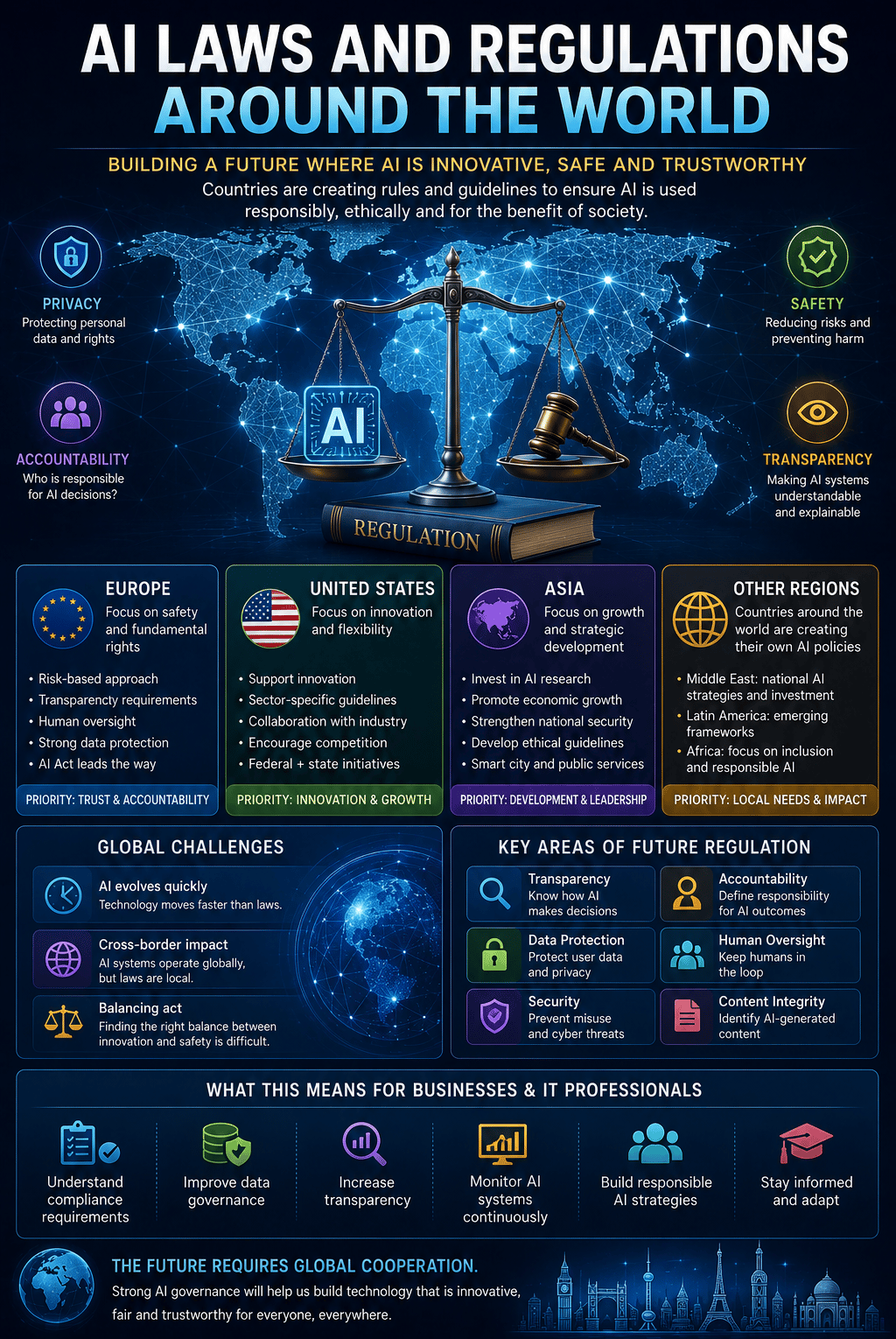
Europe: Focus on Safety and Rights
Many European initiatives focus heavily on:
Privacy protection
Transparency
Human oversight
Risk management
The general idea is:
AI systems should respect fundamental rights and protect users.
Higher-risk systems may face stricter requirements than lower-risk applications.
Europe often prioritizes:
👉 trust and accountability
United States: Innovation and Flexibility
The United States generally focuses on:
Supporting innovation
Encouraging competition
Sector-specific guidelines
Collaboration between government and industry
Instead of a single universal AI framework, approaches often vary depending on the industry.
The emphasis is often on:
👉 balancing innovation with responsibility
Asia: Rapid Development and Strategic Growth
Many Asian countries are investing heavily in AI development.
Common priorities include:
Economic growth
National competitiveness
Research and technology leadership
Smart city development
At the same time, countries are introducing policies aimed at addressing:
Security concerns
Ethical use
Data management
Global Challenges in AI Regulation
Regulating AI is not simple.
Several challenges exist:
1. Technology Evolves Quickly
AI changes faster than traditional legal systems.
By the time regulations are created, technology may already have advanced.
2. AI Crosses Borders
An AI system developed in one country may be used globally.
This creates questions such as:
Which rules apply?
Who is responsible?
How are standards enforced?
3. Balancing Innovation and Safety
Too little regulation may create risks.
Too much regulation may slow innovation.
Finding the right balance is difficult.
Important Areas Future Regulations May Focus On
As AI continues to evolve, future laws may increasingly address:
Transparency requirements
Data protection
Accountability
Ethical standards
Security measures
Human oversight
AI-generated content identification
These areas will likely become increasingly important in the coming years.
What This Means for Businesses and IT Professionals
AI regulation does not only affect governments.
Businesses and professionals also need to adapt.
Organizations may need to:
Understand compliance requirements
Improve data governance
Increase transparency
Monitor AI systems carefully
Build responsible AI strategies
For IT professionals, understanding AI regulations may become an important skill.
The Future of AI Governance
The future will likely involve greater cooperation between:
Governments
Technology companies
Researchers
Businesses
Society
Instead of one global authority controlling AI, we may see:
👉 Multiple frameworks working together.
The challenge will be creating rules that protect people while still allowing innovation to continue.
Conclusion
Artificial Intelligence is transforming the world, and laws are trying to keep pace with this rapid change.
Different countries approach regulation differently, but the overall goal remains similar:
✔ Encourage innovation
✔ Protect people
✔ Build trust
✔ Ensure responsible use of technology
The future of AI will not depend only on what technology can achieve…
👉 It will also depend on the rules and values that guide it.
Synergy
Explore AI and creativity through engaging tutorials.
Innovate
Empower
contact@humanandai.net
© 2026. All rights reserved.