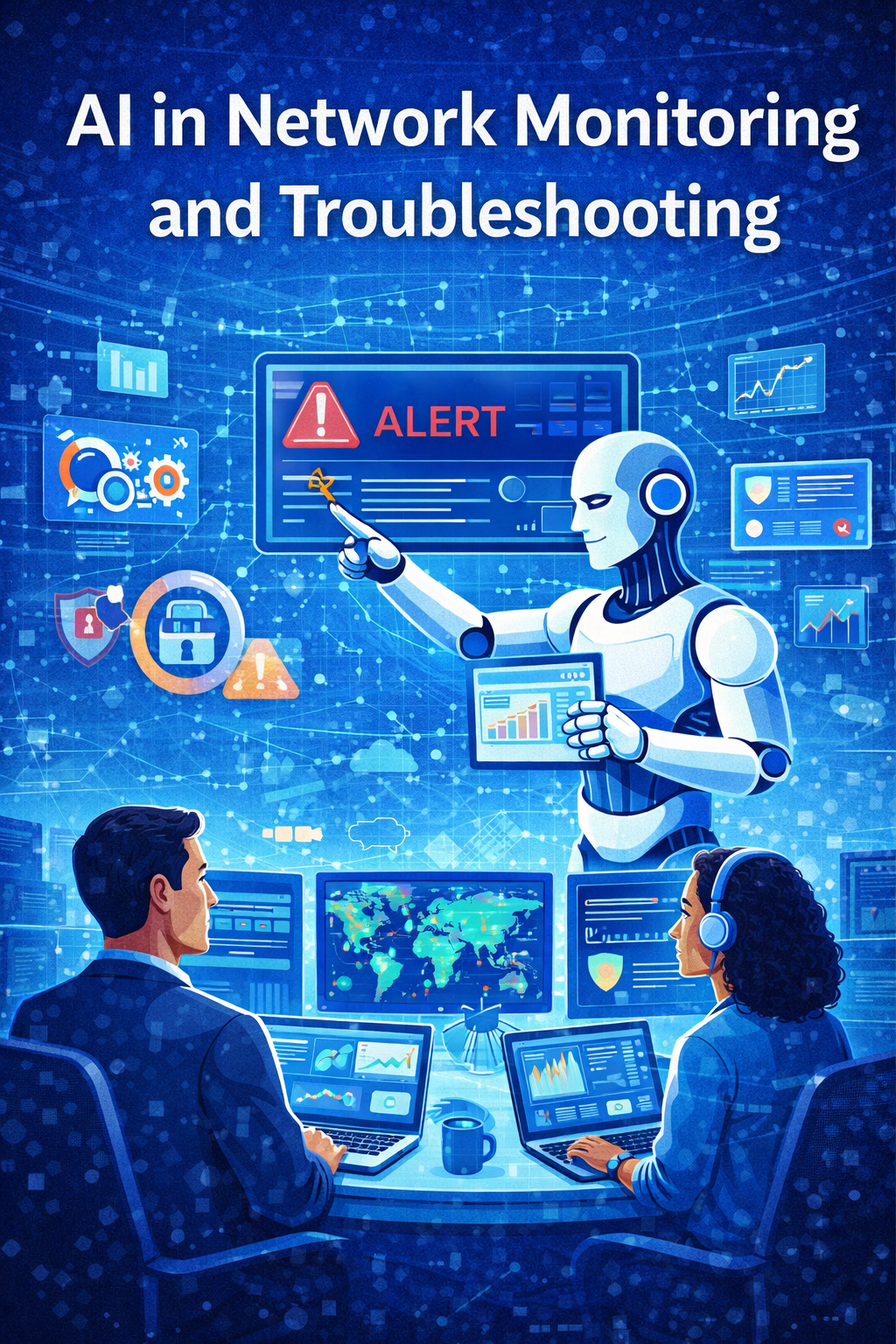
AI in Network Monitoring and Troubleshooting
Modern networks are becoming increasingly complex. Businesses rely on stable internet connections, secure data transfers, and reliable infrastructure to keep their operations running smoothly. However, monitoring large networks and identifying problems quickly can be a challenging task for IT professionals. This is where Artificial Intelligence is starting to make a major difference. AI-powered network monitoring tools can detect problems faster, analyze massive amounts of data, and even predict failures before they happen. For IT teams, this means less downtime, faster troubleshooting, and more efficient network management. Let’s explore how AI is transforming network monitoring and troubleshooting.
The Challenge of Modern Network Management
Today’s IT environments are more complicated than ever.
Organizations now manage:
Cloud infrastructure
Hybrid networks
Remote workers
IoT devices
Large volumes of data traffic
Traditional monitoring tools often rely on predefined rules and manual analysis. When something goes wrong, IT teams must search through logs, alerts, and performance metrics to find the root cause.
This process can take time — and time means potential service disruptions.
AI helps simplify this challenge.
Smarter Network Monitoring
AI systems can continuously analyze network traffic and behavior patterns.
Instead of only reacting to problems, AI can:
Detect unusual activity
Identify performance anomalies
Monitor network health in real time
Learn normal traffic behavior
By understanding what “normal” looks like, AI can quickly recognize when something is wrong.
This allows IT teams to react faster and prevent larger issues.
Predictive Problem Detection
One of the most powerful capabilities of AI is predictive analysis.
AI tools can analyze historical network data and identify patterns that may lead to future failures.
For example, AI may detect:
Gradual bandwidth congestion
Hardware performance degradation
Repeating network latency patterns
Unusual traffic spikes
Instead of discovering a problem after it occurs, AI can warn administrators before the issue becomes critical.
This proactive approach significantly reduces downtime.
Faster Troubleshooting
When network issues occur, identifying the root cause can be difficult.
AI-assisted troubleshooting helps by:
Correlating events across multiple systems
Analyzing logs automatically
Suggesting possible causes of failures
Highlighting affected devices or services
This reduces the time engineers spend manually investigating problems.
In many cases, AI can narrow down the problem in seconds instead of hours.
Improved Network Security
AI monitoring tools also contribute to network security.
By analyzing traffic patterns, AI can detect suspicious behavior such as:
Unusual login attempts
Abnormal data transfers
Malware communication patterns
Potential Distributed Denial-of-Service (DDoS) activity
Because AI learns from patterns, it can detect threats that traditional rule-based systems might miss.
This strengthens the organization’s security posture.
Reducing Alert Fatigue
One common issue in network monitoring is alert overload.
Traditional monitoring systems can generate hundreds or thousands of alerts daily, many of which may not require immediate attention.
AI helps solve this problem by:
Prioritizing alerts
Filtering false positives
Grouping related issues
Highlighting critical events
This allows IT teams to focus on what truly matters.
AI as an Assistant for Network Engineers
AI does not replace network engineers — it enhances their capabilities.
Instead of spending hours reviewing logs or manually identifying issues, engineers can focus on:
Network architecture improvements
Security strategies
Performance optimization
Infrastructure planning
AI becomes a powerful assistant, helping professionals work faster and smarter.
The Future of AI in Network Management
As networks continue to grow and become more dynamic, AI will play an even greater role.
Future developments may include:
Self-healing networks that automatically fix problems
Fully autonomous network optimization
Advanced predictive maintenance
AI-driven infrastructure management
These innovations will allow organizations to operate more reliable and resilient networks.
Conclusion
AI is transforming network monitoring and troubleshooting by bringing intelligence, automation, and predictive capabilities to IT operations.
By analyzing massive amounts of network data in real time, AI helps detect issues faster, prevent failures, and improve overall system performance.
For network engineers and IT teams, this technology is not a replacement — it is a powerful ally.
In a world where connectivity is critical, AI is helping ensure that networks remain stable, secure, and efficient.
Synergy
Explore AI and creativity through engaging tutorials.
Innovate
Empower
contact@humanandai.net
© 2026. All rights reserved.