AI in Cyber Defense: Automated Threat Response
Cybersecurity has become one of the biggest challenges of the digital age. Every day, organizations face thousands of potential threats, including malware, phishing attacks, ransomware, and unauthorized access attempts. Traditional security systems rely heavily on predefined rules and manual analysis, which can sometimes be too slow to react to modern cyber threats. This is where Artificial Intelligence is making a major difference. AI-powered cybersecurity systems can detect threats faster, analyze large volumes of security data, and automatically respond to attacks before they cause serious damage. Let’s explore how AI is transforming cyber defense and helping organizations stay protected in an increasingly complex digital world.
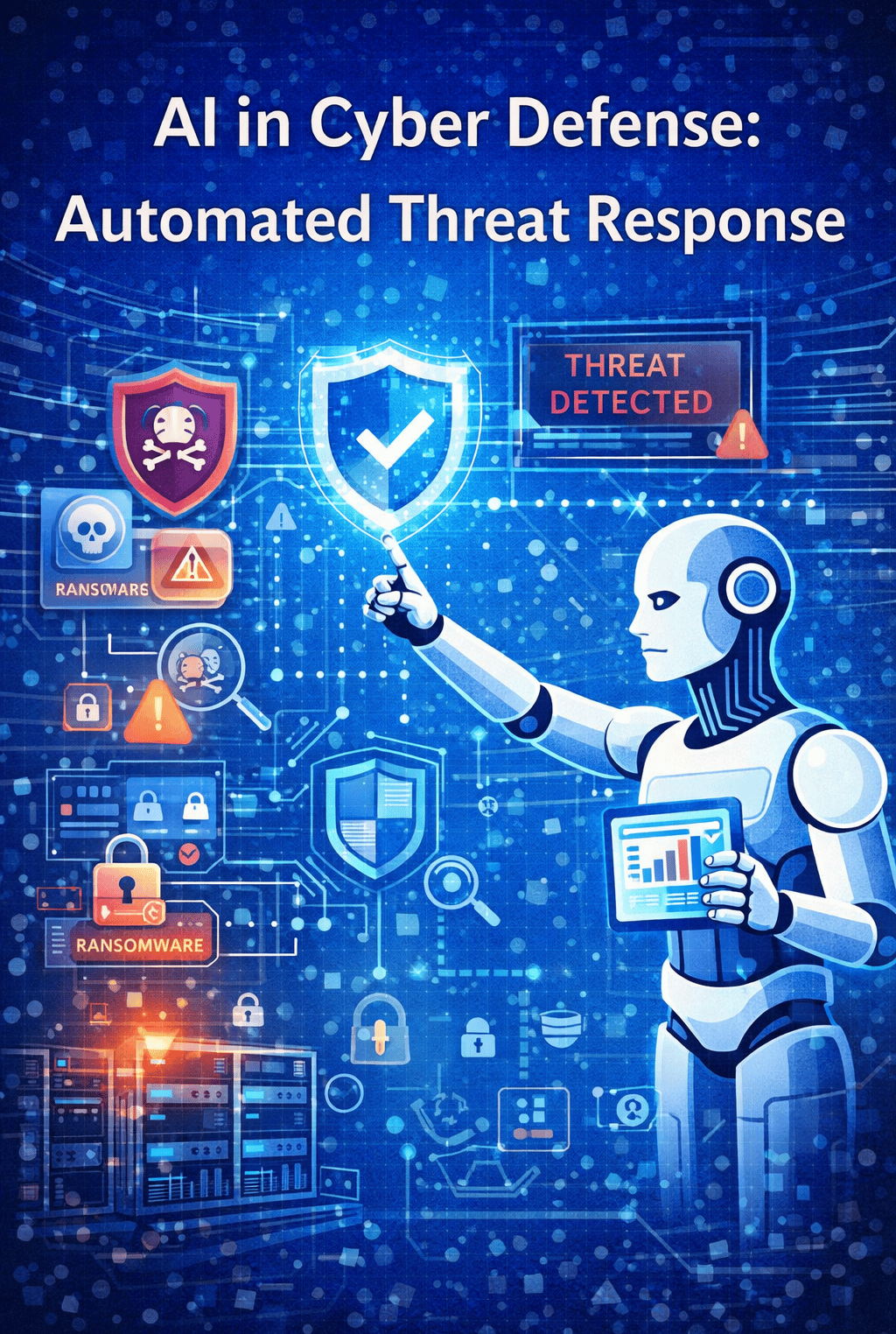
The Growing Complexity of Cyber Threats
Modern cyberattacks are more sophisticated than ever.
Attackers constantly develop new techniques to bypass traditional security tools. In large organizations, networks generate enormous amounts of data, including:
System logs
Network traffic
User activity
Authentication attempts
Application behavior
Analyzing all this information manually is almost impossible.
AI helps by continuously monitoring this data and identifying patterns that may indicate suspicious activity.
How AI Detects Cyber Threats
AI systems use machine learning algorithms to analyze behavior across networks and systems.
Instead of relying only on known attack signatures, AI can detect anomalies, such as:
Unusual login locations
Unexpected data transfers
Suspicious network traffic patterns
Rapid changes in user behavior
Unknown software activity
Because AI learns from historical data, it can recognize threats even when they have never been seen before.
This capability is critical in defending against zero-day attacks, which exploit vulnerabilities before security teams know they exist.
Automated Threat Response
One of the most powerful advantages of AI in cybersecurity is automation.
When a potential threat is detected, AI systems can automatically trigger defensive actions such as:
Blocking suspicious IP addresses
Isolating compromised devices
Terminating malicious processes
Locking user accounts temporarily
Alerting security teams
These automated responses can happen in seconds, dramatically reducing the time attackers have to cause damage.
Without automation, security teams might take minutes or even hours to react.
Reducing Security Team Workload
Cybersecurity teams are often overwhelmed by thousands of daily alerts.
Many of these alerts are false positives, which can waste valuable time and resources.
AI can help by:
Filtering alerts
Prioritizing high-risk threats
Correlating events across systems
Providing actionable insights
This allows security professionals to focus on real threats instead of noise.
AI becomes a powerful assistant that helps security teams work more efficiently.
AI in Modern Security Platforms
Many modern security tools already integrate AI technologies.
Examples include:
AI-powered firewalls that adapt to network behavior
Endpoint protection platforms that detect malware automatically
Security Information and Event Management (SIEM) systems enhanced with machine learning
User behavior analytics systems that detect insider threats
These technologies help organizations move from reactive security to proactive cyber defense.
Challenges and Limitations
Despite its advantages, AI is not a perfect solution.
Cybersecurity still requires human expertise because:
Attackers can attempt to manipulate AI systems
AI models must be trained with accurate data
Security strategies require human decision-making
Complex attacks may require deeper investigation
AI should be seen as a powerful tool for security professionals, not a replacement for them.
The best cyber defense strategies combine AI technology with experienced human analysts.
The Future of AI in Cybersecurity
As cyber threats continue to evolve, AI will play an even bigger role in protecting digital infrastructure.
In the future, we may see:
Fully automated threat containment systems
Self-learning cybersecurity platforms
Predictive threat intelligence powered by AI
AI systems that simulate cyberattacks to test defenses
These advancements will help organizations stay ahead of cybercriminals.
Conclusion
Artificial Intelligence is rapidly transforming the field of cybersecurity.
By analyzing massive amounts of data, detecting anomalies, and responding to threats automatically, AI allows organizations to defend their systems faster and more effectively.
While human expertise remains essential, AI is becoming a critical partner in modern cyber defense.
In a world where cyber threats continue to grow, the combination of human intelligence and artificial intelligence may be the strongest defense we have.
Synergy
Explore AI and creativity through engaging tutorials.
Innovate
Empower
contact@humanandai.net
© 2026. All rights reserved.