AI in Archaeology: Discovering the Secrets of the Past with Technology
Artificial Intelligence is transforming archaeology by helping researchers uncover hidden structures, analyze ancient artifacts, and reconstruct lost civilizations with unprecedented accuracy. From satellite imagery to predictive models, AI is becoming an essential tool in exploring and understanding humanity’s past.
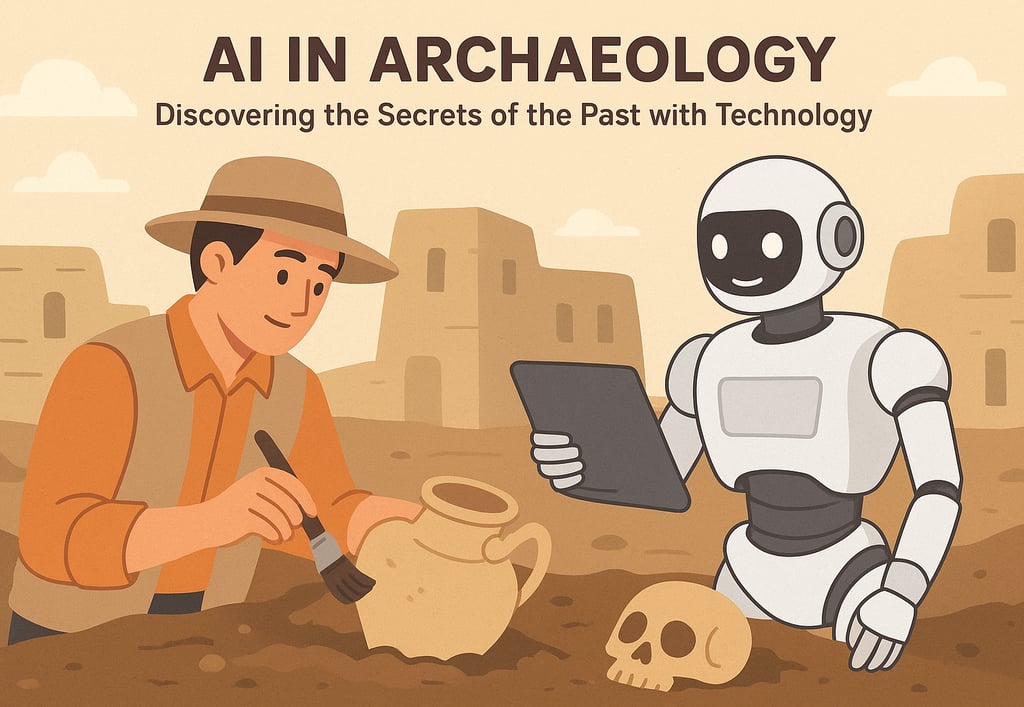
Archaeology is a window into human history — a field that uncovers lost civilizations, forgotten stories, and the evolution of our world. But in recent years, a powerful new collaborator has joined archaeologists in their quest for knowledge: Artificial Intelligence.
From analyzing ancient ruins to discovering lost cities buried under jungles or deserts, AI is transforming how experts explore the past. With advanced algorithms, massive data processing, and pattern-recognition capabilities, AI is helping humanity uncover historical secrets that were once impossible to detect.
In this article, we explore how AI is revolutionizing archaeology and opening a new era of discovery.
1. Mapping Lost Civilizations from Space
One of the most extraordinary uses of AI in archaeology is satellite image analysis.
AI systems can scan thousands of images — far faster than any human — to detect patterns that indicate buried structures, ancient roads, and forgotten settlements.
What AI can reveal from above:
Unusual soil disturbances
Subtle geometric patterns
Vegetation irregularities
Elevation shifts invisible to the human eye
This technology led to discoveries such as:
Lost Mayan cities hidden under dense jungle
Ancient Roman roads invisible on the surface
Egyptian settlements buried under shifting sands
AI makes it possible to explore locations that would take humans decades to study manually.
2. Reconstructing Artifacts and Ruins
Broken pottery, fragmented statues, and collapsed structures used to require years of manual reconstruction. Today, AI can perform digital restoration in minutes.
How AI helps restore the past:
Predicts missing fragments
Suggests original shapes
Reconstructs colors and patterns
Builds 3D models of ruins and ancient buildings
This allows archaeologists to visualize entire cities or temples in their original state — even when only small pieces survive.
3. Decoding Ancient Languages
Some ancient scripts remain partially or completely undeciphered.
AI is helping decode languages that haven’t been understood for thousands of years.
AI can:
Detect recurring patterns in symbols
Compare scripts across civilizations
Reconstruct missing words
Translate languages with no living speakers
Researchers have already used AI to analyze:
Sumerian cuneiform
Egyptian hieroglyphs
Mayan glyphs
The ancient Greek Antikythera mechanism inscriptions
With AI, languages once considered “lost forever” now have a chance to be understood.
4. Protecting Archaeological Sites
Archaeological treasures are often threatened by:
Looting
Natural disasters
Climate change
Urban development
AI helps monitor and protect sites through:
Real-time satellite surveillance
Automated detection of illegal activities
Predictive models that identify areas at high risk
This gives conservation teams the ability to react faster and safeguard humanity’s heritage.
5. Bringing History to Life
AI doesn't just uncover the past — it helps recreate it.
Using machine learning and 3D visualization, scientists can:
Rebuild ancient environments
Simulate how people lived
Recreate clothing, tools, and architecture
Generate historical animations for museums and documentaries
This makes history more accessible and engaging for everyone.
Conclusion: AI — A New Archaeological Partner
Artificial intelligence is not replacing archaeologists — it is empowering them.
With AI’s ability to analyze massive datasets, detect hidden patterns, and reconstruct ancient worlds, humanity is entering a new era of discovery.
AI makes archaeology faster, safer, and more accurate, allowing us to uncover stories buried for thousands of years.
Together, humans and AI are rewriting our understanding of the past — and opening new possibilities for the future.
Synergy
Explore AI and creativity through engaging tutorials.
Innovate
Empower
contact@humanandai.net
© 2026. All rights reserved.