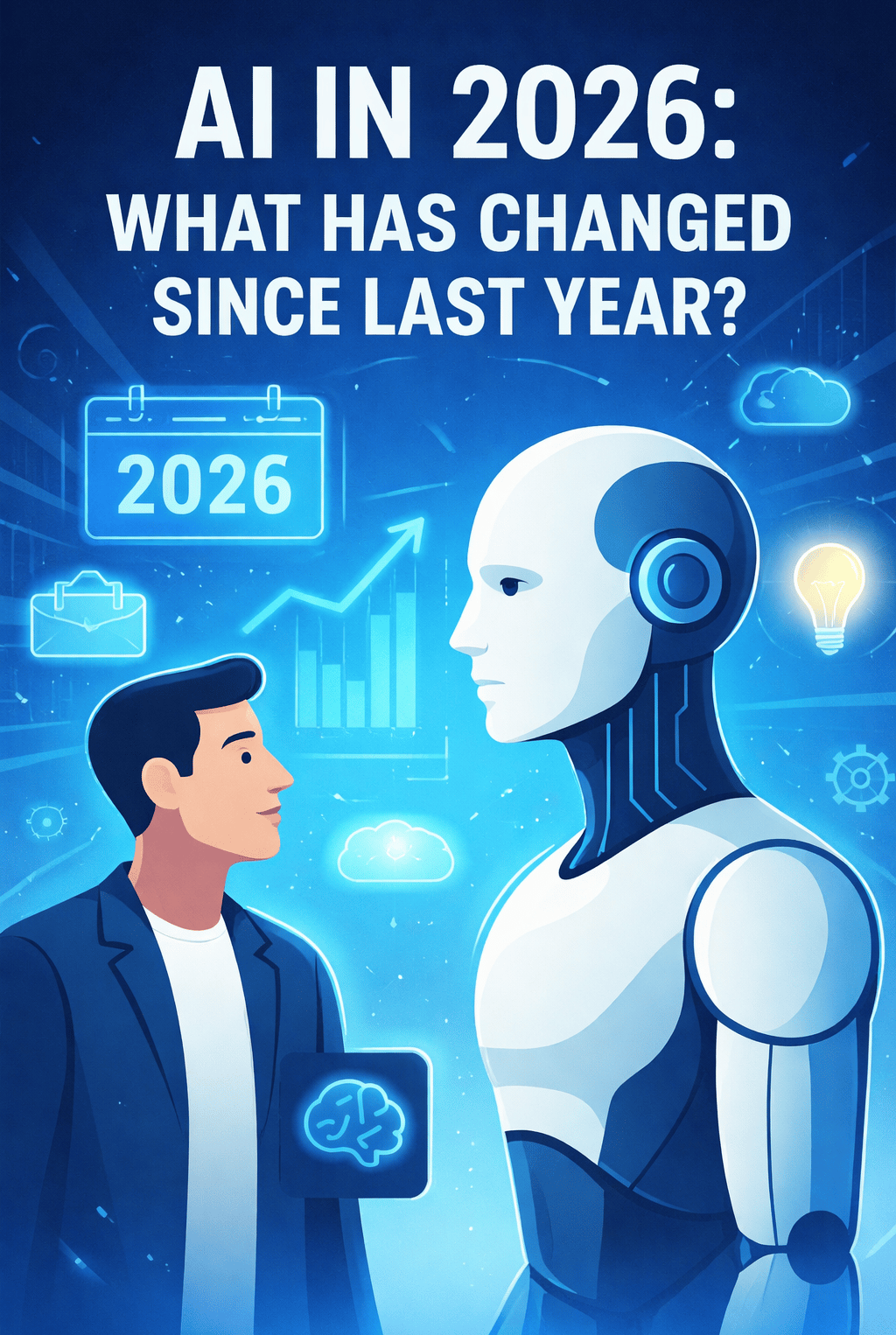
AI in 2026: What Has Changed Since Last Year?
As we step into 2026, artificial intelligence is no longer a futuristic concept or a trending buzzword — it has become part of our everyday reality. Compared to last year, AI hasn’t just evolved technically; it has also changed how we work, learn, communicate, and think about technology itself. So, what really changed since 2025? And what does it mean for us as humans living alongside increasingly intelligent machines?
From Experiment to Everyday Tool
In 2025, many people were still testing AI. In 2026, most are using it daily.
AI has moved:
From “interesting experiments”
To trusted assistants embedded in phones, apps, cars, workplaces, and homes
People no longer ask “Should I use AI?”
Instead, the question has become:
“How can AI help me do this faster, better, or smarter?”
Smarter, More Context-Aware AI
One major shift is how AI understands context.
Modern AI systems in 2026:
Better understand intent, not just commands
Adapt responses based on user behavior and preferences
Handle more complex, multi-step tasks
This makes AI feel less like a tool and more like a collaborator — especially in work environments, education, and creative fields.
AI Is Everywhere — Often Invisibly
Another big change is visibility.
Many people use AI every day without realizing it:
Spam filters and cybersecurity systems
Smart cameras and traffic systems
Recommendation engines in apps and platforms
Background automation in IT infrastructure
AI has quietly moved behind the scenes, becoming a silent engine that keeps systems running smoothly.
Growing Awareness of Limits and Risks
While enthusiasm for AI has grown, so has realism.
In 2026, more people understand that:
AI can make mistakes
AI reflects the data it was trained on
AI needs human supervision and responsibility
Discussions around ethics, bias, privacy, and over-reliance are no longer niche topics — they are mainstream conversations involving governments, companies, and everyday users.
Humans Are Still in Control — and Must Stay There
Perhaps the most important change isn’t technological, but human.
We’re learning that:
AI should support, not replace, human judgment
Critical thinking is more important than ever
Skills like creativity, empathy, and ethics remain uniquely human
AI has grown smarter — but it still needs human direction, values, and accountability.
Looking Ahead
AI in 2026 feels more mature, more useful, and more integrated than ever before.
But its future depends not only on innovation — it depends on how we choose to use it.
The real progress isn’t just smarter machines.
It’s smarter humans working with them.
Final Thought
AI has changed a lot since last year.
But the most important question remains the same:
How do we use AI to improve life — without losing what makes us human?
Synergy
Explore AI and creativity through engaging tutorials.
Innovate
Empower
contact@humanandai.net
© 2026. All rights reserved.