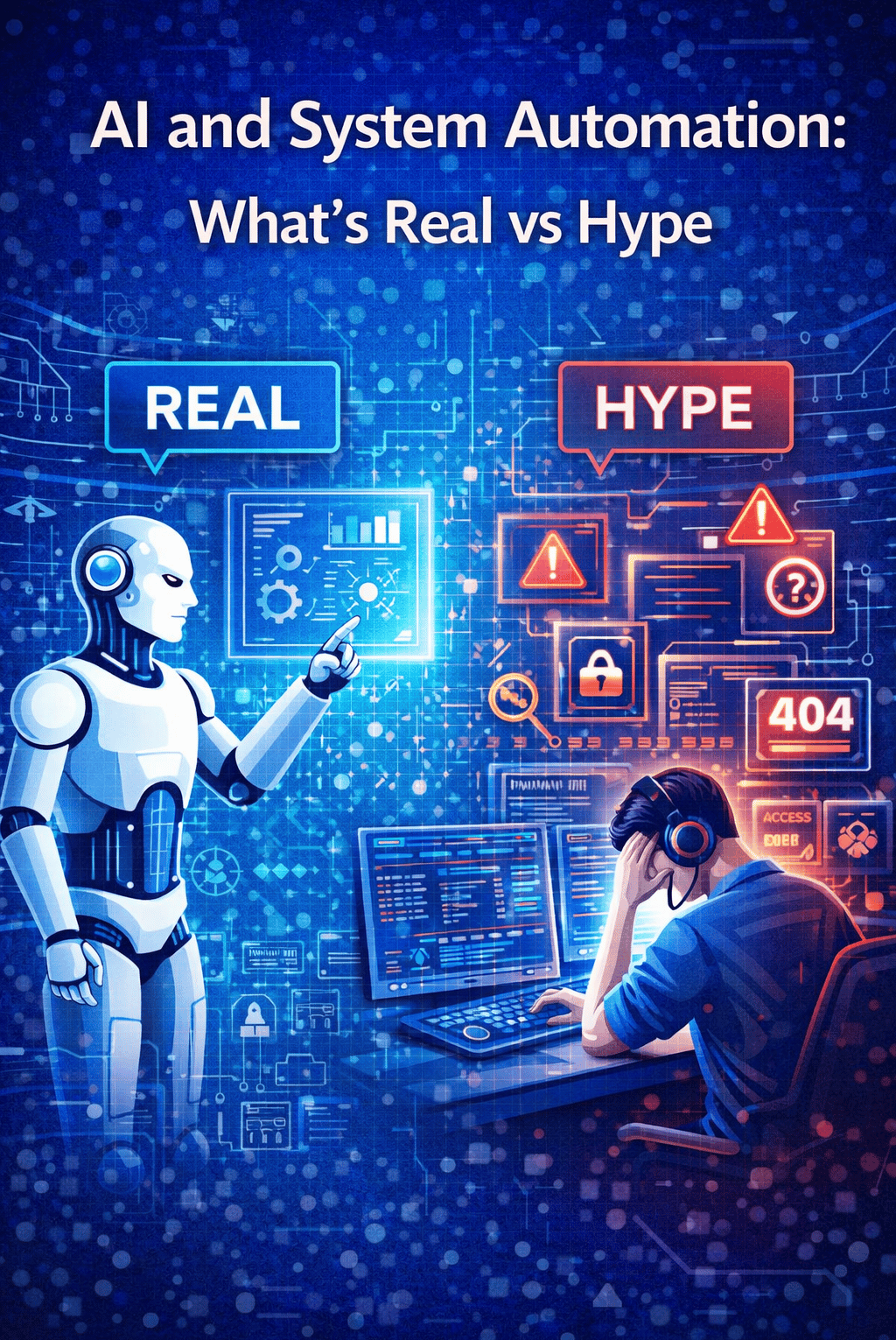
AI and System Automation: What’s Real vs Hype
Introduction Artificial Intelligence and system automation are often presented as revolutionary technologies that can run entire infrastructures with little to no human involvement. From “self-healing systems” to “fully autonomous IT environments,” the promises sound impressive — sometimes even unrealistic. But how much of this is actually real? In this article, we’ll separate reality from hype and explore what AI can truly do today in system automation — and where human expertise is still essential.
The Promise of AI-Driven Automation
The idea behind AI in system automation is simple:
👉 Let machines handle repetitive tasks, detect problems, and even fix them automatically.
In theory, this means:
No more manual monitoring
Faster incident response
Reduced human error
Fully optimized systems
This vision has attracted a lot of attention — and a lot of exaggeration.
What’s Real: Automation Is Already Everywhere
AI-driven automation is not just theory. It’s already used in many real-world environments.
✅ 1. Automated Monitoring and Alerts
Modern systems can:
Monitor performance in real time
Detect anomalies
Trigger alerts automatically
This reduces the need for constant manual supervision.
✅ 2. Scripted and Intelligent Automation
IT teams use automation tools to:
Deploy systems
Configure servers
Manage updates
Execute predefined actions
With AI, these processes can become more adaptive and efficient.
✅ 3. Predictive Maintenance
AI can analyze historical data to predict:
Hardware failures
Performance degradation
Capacity issues
This allows teams to act before problems occur.
✅ 4. Basic Self-Healing Actions
Some systems can already:
Restart services automatically
Reallocate resources
Scale infrastructure based on demand
These are early forms of “self-healing systems.”
What’s Hype: Fully Autonomous IT Environments
Now let’s talk about the exaggeration.
❌ “AI Can Run Everything Alone”
Reality:
AI still needs:
Configuration
Supervision
Decision-making from humans
Complex environments require human understanding and judgment.
❌ “No More IT Engineers Needed”
Reality:
AI changes the role — it doesn’t eliminate it.
Engineers are still required to:
Design systems
Define automation rules
Handle complex incidents
Ensure security and compliance
❌ “AI Never Makes Mistakes”
Reality:
AI can:
Misinterpret data
Trigger wrong actions
Overreact to anomalies
Without proper control, automation can create new problems instead of solving them.
❌ “Self-Healing Systems Solve Everything”
Reality:
Self-healing works best for known issues.
For unknown or complex problems:
👉 Human intervention is still necessary.
The Real Role of AI in System Automation
Instead of replacing IT teams, AI plays a different role:
👉 It amplifies efficiency.
AI helps by:
Reducing manual workload
Speeding up operations
Providing insights
Supporting decision-making
The goal is not full autonomy.
The goal is smart collaboration between humans and machines.
The Balance Between Automation and Control
Too little automation:
❌ Slow processes
❌ High workload
❌ Increased human error
Too much automation:
❌ Loss of control
❌ Hidden failures
❌ Over-reliance on systems
The best approach is controlled automation:
✔ Automate repetitive tasks
✔ Keep humans in decision loops
✔ Monitor automated systems
✔ Continuously improve processes
What This Means for IT Professionals
For IT engineers and managers (especially you now 😄), the future is clear:
Success will depend on:
Understanding automation tools
Knowing when to trust AI
Maintaining control over systems
Combining experience with technology
AI is not replacing expertise — it is increasing its importance.
The Future: Smarter, Not Fully Autonomous
AI will continue to improve system automation.
We will see:
More advanced predictive systems
Better anomaly detection
Improved automation workflows
Partial autonomy in controlled environments
But fully autonomous IT environments without humans?
👉 Not anytime soon.
Conclusion
AI in system automation is powerful — but it is often misunderstood.
What’s real:
✔ Faster monitoring
✔ Automated processes
✔ Predictive insights
✔ Improved efficiency
What’s hype:
❌ Fully autonomous systems
❌ No need for IT professionals
❌ Perfect decision-making
The truth lies in the middle.
AI is not here to replace humans — it is here to help us build smarter, more efficient systems.
And in the end, the most successful environments will always be those where human intelligence and artificial intelligence work together.
Synergy
Explore AI and creativity through engaging tutorials.
Innovate
Empower
contact@humanandai.net
© 2026. All rights reserved.