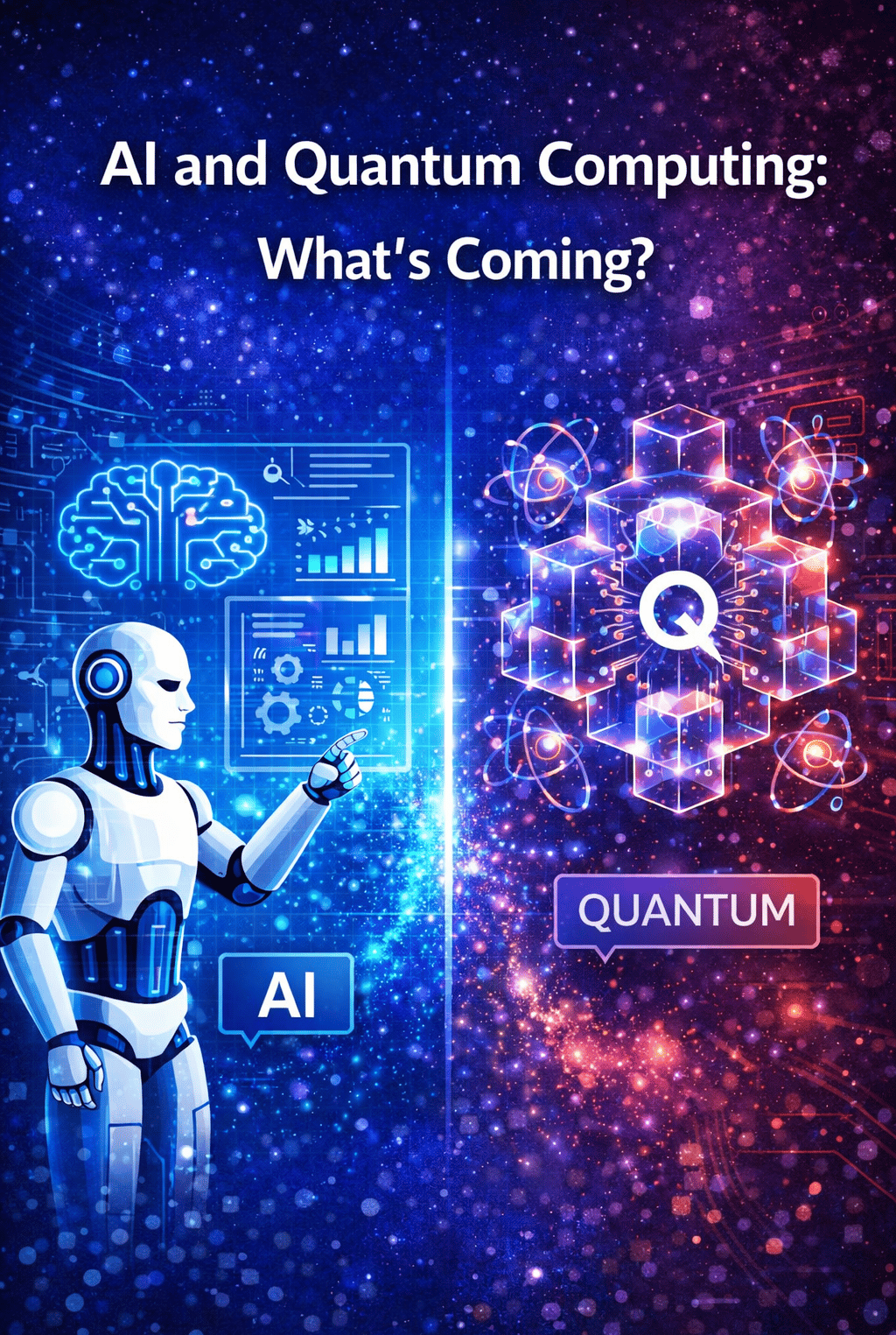
AI and Quantum Computing: What’s Coming?
Introduction Artificial Intelligence is already transforming the way we work, communicate, and solve problems. At the same time, another powerful technology is quietly evolving in the background: quantum computing. Individually, both technologies are impressive. But together? 👉 They have the potential to redefine what computers can do. In this article, we’ll explore what quantum computing is, how it connects with AI, and what the future might look like when these two technologies work together.
What Is Quantum Computing (Simplified)
Traditional computers use bits:
👉 0 or 1
Quantum computers use qubits, which can be:
👉 0, 1, or both at the same time
This property, called superposition, allows quantum computers to process massive amounts of information simultaneously.
Another important concept is entanglement, where qubits become interconnected and influence each other instantly.
In simple terms:
👉 Quantum computers can solve certain problems much faster than classical computers.
Why AI Needs More Computing Power
AI systems rely heavily on:
Data processing
Pattern recognition
Training large models
Complex calculations
As AI becomes more advanced, it requires:
👉 More data
👉 More processing power
👉 Faster computation
Traditional computing is already being pushed to its limits in some areas.
This is where quantum computing could help.
How Quantum Computing Can Enhance AI
The combination of AI and quantum computing is often called:
👉 Quantum AI
Here’s what it could enable:
✅ 1. Faster Machine Learning
Training AI models today can take:
Hours
Days
Even weeks
Quantum computing could reduce this dramatically by processing multiple possibilities at once.
✅ 2. Solving Complex Optimization Problems
Many industries rely on optimization:
Logistics
Supply chains
Network routing
Financial modeling
Quantum AI could find optimal solutions much faster and more efficiently than current systems.
✅ 3. Advanced Data Analysis
Quantum systems could analyze extremely large datasets and uncover patterns that are currently impossible to detect.
This could lead to breakthroughs in:
Medicine
Climate science
Cybersecurity
Engineering
✅ 4. Improved Simulation Capabilities
Quantum computing can simulate complex systems, such as:
Molecules
Materials
Physical processes
When combined with AI, this could accelerate discoveries in science and technology.
What’s Still a Challenge
Despite the potential, quantum computing is still in early stages.
Major challenges include:
High error rates
Hardware limitations
Expensive infrastructure
Difficulty in programming quantum systems
Most current quantum computers are still experimental.
We are not yet at the point where quantum AI is widely usable.
What’s Hype vs Reality
Just like with AI, there is also hype around quantum computing.
❌ Hype
“Quantum computers will replace all classical computers soon”
“AI will instantly become superintelligent”
“All problems will be solved overnight”
✅ Reality
Quantum computing will complement classical systems
It will be used for specific types of problems
Adoption will take years, not months
When Will We See Real Impact?
Experts estimate:
Short-term (next 5 years):
→ Experimental use, research, limited applicationsMedium-term (5–10 years):
→ Early real-world use cases in specific industriesLong-term (10+ years):
→ Broader integration with AI and enterprise systems
This means:
👉 The future is coming — but gradually.
What This Means for IT Professionals
For someone like you, Paul 😄 (and your audience), this is important.
You don’t need to become a quantum expert tomorrow.
But you should:
Be aware of the technology
Understand its potential
Follow its evolution
Be ready to adapt when it becomes practical
Just like AI today, quantum computing will eventually become part of the IT landscape.
The Bigger Picture
AI + Quantum Computing represents a shift toward:
👉 next-generation computing
This could lead to:
Faster innovation
Smarter systems
New industries
Solutions to problems we cannot currently solve
It’s not just an upgrade.
It’s a transformation.
Conclusion
Quantum computing and AI together have the potential to unlock a new era of technological progress.
While the technology is still developing, its impact could be significant in the years ahead.
What’s important is to stay informed, curious, and open to change.
Because just like AI reshaped the present…
👉 Quantum computing may help define the future.
Synergy
Explore AI and creativity through engaging tutorials.
Innovate
Empower
contact@humanandai.net
© 2026. All rights reserved.